Shanghai – the movie

Shanghai,the movie
Shanghai,the movie

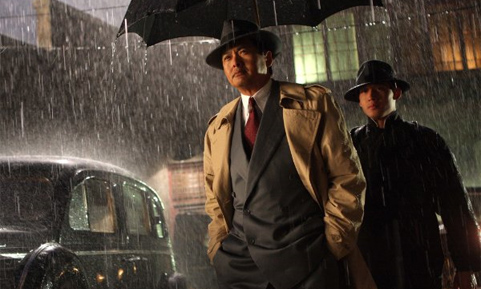
As old Shanghai is getting more and more popular, so do movies about the period. Following the steps of “Empire of the Sun“,” Tian Tang Kou” and “Lust caution“, this Hollywood old Shanghai movie comes with very high expectations. Recently presented at the Shanghai International Film festival, it is already shown in theaters in Shanghai but will only see its debut in America in September. Just like the Majestic theater was the perfect setting for viewing a 1930’s themed musical (see post about 42nd street), the best place to see the an Old Shanghai movie is surely the Grand Theater on People Square.

John Cusack plays an American agent posing as a pro-Nazis journalist coming from Berlin. He comes to Shanghai after the death of his best friend, killed in the Japanese controlled area. Reaching Shanghai just before Pearl Harbor and the invasion of the International Settlement by the Japanese troops, Cusack finds himself in a love triangle with Gong Li and her husband played by Cho Yung Fat. Chased by General Tanaka played by Ken Watanabe, they will go through all the trouble to find the murderer and help the resistance against the Japanese invader. The movies mixes a number of genres such as spy and gangster movie, romance and historical movie. Although not filmed in China but in Thailand, it captures perfectly the atmosphere of Shanghai. Quite a number of scenes are taken under a pouring rain that will be familiar to people actually living in the city. With its film noir atmosphere, it create a kind of wet version of Casablanca perfectly matching the dark image of the period. The Shanghai created in the movie is also pretty good from a visual and historical point of view. The scenarist and set makers have clearly make their homework and there is little in the movie that does not fit right in the look or the history books.

With my strong interest in Old Shanghai, I am surely not the best person to judge this movie independently. A few critics of the movie complained about the confused historical background. For me it was crystal clear, but I’m not sure how easy it is to understand with no prior knowledge about the topic. In any case, it is a great movie to watch, an achievement in term of picture and atmosphere and a true enjoyable time. You can see a trailer with the following link: Trailer
East Wind, Rain poster

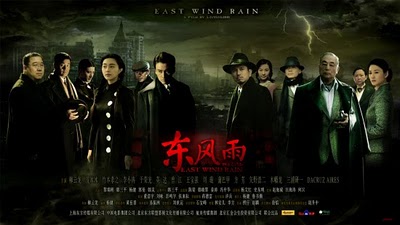
Shanghai, the movie is not the only large scale movie based on this period. “East Wind, Rain” also takes place in the same background, with spies acting betwen Kuomintang and the Japanese army. The 4 minutes long introduction session is superb, including the re-created dog race just like that one that existed in the French Concession on Rue Cardinal Mercier (Now Shaanxi lu, the building was used as a flower market until being teared down a few years ago). A lot of attention was given to make the movie look good, however the action is far to slow not making the movie really interesting beyond the pretty introductory scene. As a movie, Shanghai is just so much better.

Empire of the Sun

I remember the movie’s poster when it came out in 1987. Steven Spielberg was already famous, though not the star that he is now but the movie was much talked about. I did not see it then, and it’s only recently that I realized its connection with old Shanghai.
Based on life of JG Ballard, Empire of the Sun tells the story of a young English boy left alone in Shanghai during the 1941 Japanese invasion of the International Settlement and his life throughout the war until being re-united with his parents in 1945. The most interesting was that the movie was fully filmed in Shanghai in 1986, before the real estate boom in Shanghai.
The first part of the movie takes place in the city itself and the remake of old Shanghai is simply stunning. The scene on the Suzhou creek bridge is exactly as one can see on the period photographs. The movie makers imported old cars and rebuilt parts that had been destroyed. The scene overlooking the Bund is also amazing with the level of details involved. The Bund used to be a street as well as a parking lot with a little cabin in the middle. The actual movie looks just like the old postcards. They even rebuilt the WWI victory statue that was destroyed during the Japanese occupation of the settlement. There is also a scene in front of a theater that is located just behind the Bund and was used as a club called New York New York a few years later. The movie perfectly rebuilt the crowd and atmosphere of the period and its clear that historians were involved to recreate the past. The most stunning was the documentary on the DVD, showing pictures of the Bund in 1986… helping to understand the enormous work involved for the decors. The film also involved hundreds (if not thousand) of people for creating the enormous crowd of refugees and people pushed back by the Japanese army invading the settlement. One scene was even filmed in the Peace hotel overlooking the Bund. The scenes with the Japanese army coming into the settlement are also very impressive, and must have brought back a lot of memories to many Chinese people who went through this period.
With a good knowledge of Shanghai, it’s also easy to spot the points that were not actually filmed on the spot. In particular, what is supposed to be the Cathay Hotel entrance (with a Cathay Hotel sign) is certainly not the actual hotel entrance. The villa where the boy live with his parents is also not in Shanghai. I have not seen any picture of this particular villa in Shanghai, and it would have been in a much too good state after 40 years of bad treatment. Moreover, buildings where built after 1949 in most gardens of the original villas as the density of people increase rapidely. I believe that the villa scenes inside and outside were filmed in England… in villas from the same period. The neighboring villas are Faux-Tudor like the ones in Shanghai and were probably built in the same period as well.
Finally, the camp scenes were not filmed in China. First of all, the sandy desert ground is surely not in the Shanghai region but looks much more like spain (one of the filming location). However, the style of the buildings re-created is very near to the original Shanghai style and the remake of the LongHua Pagoda (near which JG Ballart was actually interned) is also very close to the original. The only thing missing is the LongHua airport terminal that would have been between the tracks and the pagoda… i.e. exactly where the camp is build. One point I am not sure of yet, is where the green house of the ending scene is. It could be the one of the Shanghai botanical garden, but it also could be in many other places.
In any case, the remake of old Shanghai in the city itself is just amazing, and the attention to details given to the other parts of the movie make it a must see for Old Shanghai enthusiasts. For current Shanghai resident, it is amazing to see how Xu Jia Hui looked like before thre real estate boom of the 90’s and later. I wish the more recent movies about old Shanghai would pay such an attention to details.

Paradise

Tian Tang Kou
Tian Tang Kou

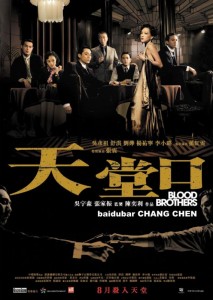
Blood brothers had a such a great trailer, it was impossible to miss. It promised it all, Chinese Shanghai gangsters, 1920’s decor, a beautiful singer girl that all man are dreaming of, shotguns fight and old cars… and the movie delivers. To add a little bit of flavor to it, I went to watch it in the historical Cathay theater on the old Avenue Joffre (nowadays Huai Hai Lu).

Tian Tang Kou (Paradise’s door), or Blood brothers in English, is a traditional gangster movie. 2 young guys from the the village are taken in town by an older brother. They first struggle with low jobs, such as pulling rickshaws until they get introduced to the boss gang. As small bits of the big organization, they get protected by it and not getting anywhere, until they get a bigger mission which is the turning point. They have to choose between going away or getting really big trouble within the gang and through it to get introduced to the big boss. Climbing in the organization bring them benefits and honors, but also dilemma. Ultimatelty, the older brother kills the boss of the city gangs, and take his place. The movie finishes with a grand gun fight scene, where the evil boss gets killed by the younger one, who just goes back to his home in the countryside, leaving the city behind him.

Despite massive marketing, Tian Tang Kou was not a big success in China. It’s really a pitty, as the movie really recreates the 1920’s-30’s Shanghai atmosphere. It has a good plot, great decors and costums. The special effects are also excellent, but the best is probably the whole atmosphere of the movie. There has been movies and TV series about gangsters in old Shanghai, but this one is probably the best and certainly the more thoroughly researched. It’s great fun to watch for all old Shanghai lovers.