Shanghailander on French TV

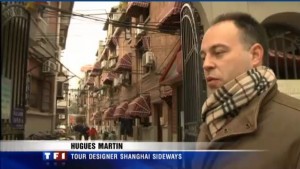
Shanghailander on TF1

The blog Shanghailander.net was started a few years ago to tell stories about Old Shanghai to my friends in the city. It has now grown much further than this primary objective. There are about 800 people a month reading the blog online along with many others subscribing to the RSS feed. Foreigners who actually lived in Old Shanghai in the 1930’s wrote to me and I have even been involved in writing articles about the topic as well as becoming the tour designer for Shanghai Sideways.

The latest development has been TV programs. As many journalists came to cover the Shanghai EXPO 2010, they also were looking for other topics and point of view of the city. This lead to  3 French TV programs that were all recently broadcasted.  The  latest one was last Saturday on the main French TV station TF1. It’s a short program within the lunch time news showing a introduction to foreign style architecture in Shanghai. It can be viewed at: http://videos.tf1.fr/jt-we/le-pavillon-francais-vitrine-de-la-france-a-shanghai-5928495.html

The second one was a much longer 52 minutes report on EXPO 2010 and Shanghai history for ARTE TV, a French-German cultural channel. The section I took part of lasts for 10-15 mins and is focused again on Shanghai history and what remains of it today. It includes a number of footage in old Shanghai’s villas as well as an interview shot while driving my sidecar. It was broadcasted on French TV Channel arte last week, but will be shown again on 20th July at 5:00 am and on 31st July at 12:55 am. It can also be viewed at: http://videos.arte.tv/fr/videos/shanghai_dreams-3310384.html

The last one was a 52 minutes report broadcasted on French cable TV Telemaison. The 10 minutes part I appear in is also focused on Shanghai history, unfortunately it is not available on the internet. I only have it on DVD at home.
I have also been working on a series of documentaries about Shanghai history for Shanghai based channel Dragon TV, The film will be in Chinese which was a great challenge. It is still in production at the moment.
Old Shanghai tramways

As Shanghai grew as a metropolis, in the first half of the XXth century, transportation became a serious issue, just as it is today. Although the city was not united, cut in three sections (the International Settlement, the French Concession and the Chinese City), investments were still made to develop the city. The first phases included actually paving the roads and building the dam to stabilize the Bund. As the city extended westward, much larger scale investments were required.

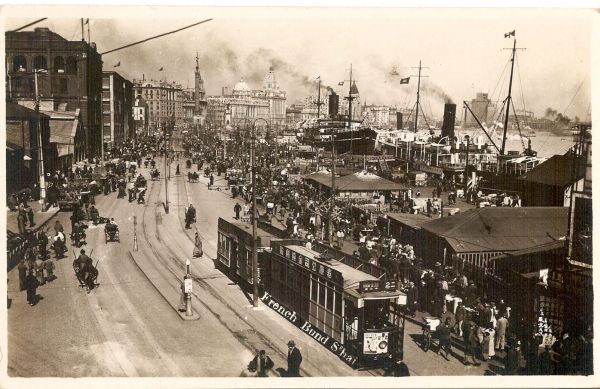
Tramways on the French Bund

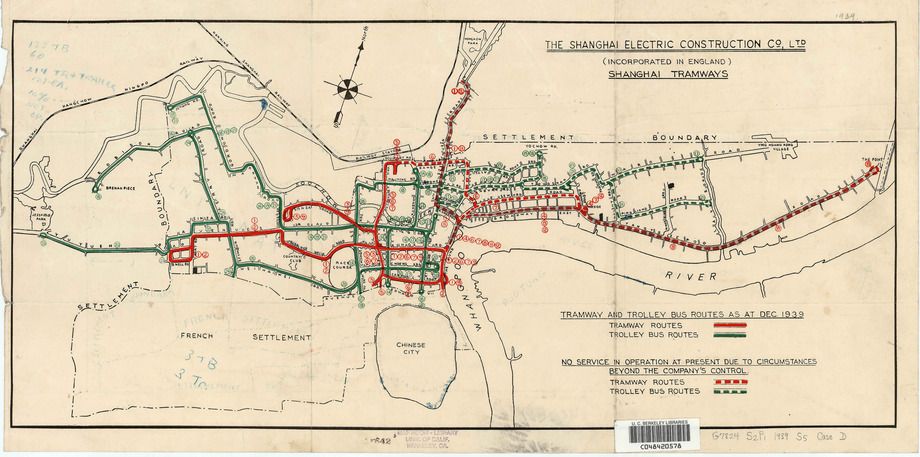
The fast growing city considered having tramway as early as 1898, but it is only in 1908 that the network actually opened. Three networks were created, ‘Shanghai Tramways’ run by the Shanghai Electric Construction Co Ltd in the International Settlements, ‘La Compagnie Francaise de Tramways et d’eclairage electrique de Changhai‘ in the French Concession and the ‘Chinese Tramways company’ in the Chinese city. Originally, the lines were connecting, but not the tracks, so passengers crossing a border had to disembark and get into the car from the next company. This was changed later, see below). Just like today’s metro, Shanghai tramways were essential for the life of the city.

Map of the International Settlement tram network

Down the Bund: The tram line was crossing the Suzhou river at the Garden Bridge (or Waibaidu Bridge) going all the way down the Bund down to the French Bund where it connected to the French Concession network. Not all lines were going the whole Bund down, but line number #2 from “Bubbling well road” (today Jing An Si), to ‘” “Marché de l’Est”, at the end of “Rue de la porte de l’Est”, today Dong Men lu.

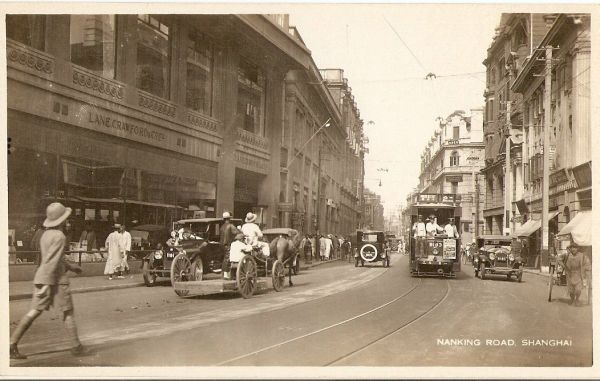
Nanking Road tramways – Line 2

Nanking Road / Bubbling well (currently Nanjing Road East and West): Crossing the international settlement from East to West, the line went up to Jing An temple. As indicated on picture left, this was tramway line number 2. It had a very similar route to the today’s metro line #2 and part of Tramway line # 20

Avenue Joffre (today Huai Hai lu): The main line of the French Concession was crossing the French Concession throughout the urban part all the way to the end of the concession near Xu Jia Hui. Going down avenue Joffre (today Huai Hai Lu), the route was going first going through the heart of the French Concession, turning left on Route Prospère Paris (today Tianping lu) through a less urbanised part built only in the 1930’s, finishing at Xu Jia Hui jesuit center.

There was also other lines going down Seymour Road / Avenue du Roy Albert (the current Shaanxi Bei lu and Shaanxi Nan lu. The same road is still followed by a trolleybus line.

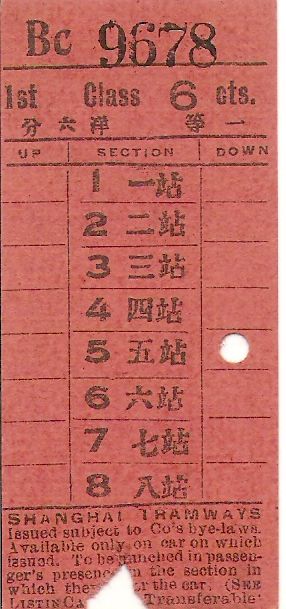
Shanghai tramway ticket

Picture right is a tramway ticket from Old Shanghai. It is from the Shanghai tramways company, in the international settlement. Although it is difficult to date, it is clearly from the 1930s or before. The ticket shows 8 possible routes (a 1931 list shows 11 routes so it probably from the 1920s). This ticket was punched for route 5, “Railway station to West Gate Via Boundry, North Chekiang, Chekiang, Hoopeh and Rue Hue”.

Along with the tramways, the Shanghai Electric Construction Company also built a network of “Trackless trolleys” in the 1930s. Shanghai also had a competing bus network, green double-decker vehicles very similar to the ones used in Britain and in Hong Kong. They were operated by the China General Omnibus Company.

Shanghai tramways were stopped in the 70’s and the tracks removed but as seen above current lines often follow the same route as the old tramways.

More about tramways in other Chinese cities with this article from Paul French’s blog:
http://www.chinarhyming.com/2009/02/25/chinas-old-tram-systems-a-quick-round-up/

Shanghai – the movie

Shanghai,the movie
Shanghai,the movie

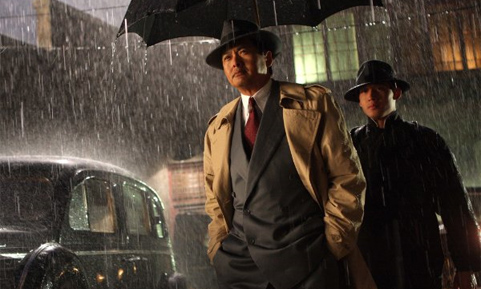
As old Shanghai is getting more and more popular, so do movies about the period. Following the steps of “Empire of the Sun“,” Tian Tang Kou” and “Lust caution“, this Hollywood old Shanghai movie comes with very high expectations. Recently presented at the Shanghai International Film festival, it is already shown in theaters in Shanghai but will only see its debut in America in September. Just like the Majestic theater was the perfect setting for viewing a 1930’s themed musical (see post about 42nd street), the best place to see the an Old Shanghai movie is surely the Grand Theater on People Square.

John Cusack plays an American agent posing as a pro-Nazis journalist coming from Berlin. He comes to Shanghai after the death of his best friend, killed in the Japanese controlled area. Reaching Shanghai just before Pearl Harbor and the invasion of the International Settlement by the Japanese troops, Cusack finds himself in a love triangle with Gong Li and her husband played by Cho Yung Fat. Chased by General Tanaka played by Ken Watanabe, they will go through all the trouble to find the murderer and help the resistance against the Japanese invader. The movies mixes a number of genres such as spy and gangster movie, romance and historical movie. Although not filmed in China but in Thailand, it captures perfectly the atmosphere of Shanghai. Quite a number of scenes are taken under a pouring rain that will be familiar to people actually living in the city. With its film noir atmosphere, it create a kind of wet version of Casablanca perfectly matching the dark image of the period. The Shanghai created in the movie is also pretty good from a visual and historical point of view. The scenarist and set makers have clearly make their homework and there is little in the movie that does not fit right in the look or the history books.

With my strong interest in Old Shanghai, I am surely not the best person to judge this movie independently. A few critics of the movie complained about the confused historical background. For me it was crystal clear, but I’m not sure how easy it is to understand with no prior knowledge about the topic. In any case, it is a great movie to watch, an achievement in term of picture and atmosphere and a true enjoyable time. You can see a trailer with the following link: Trailer

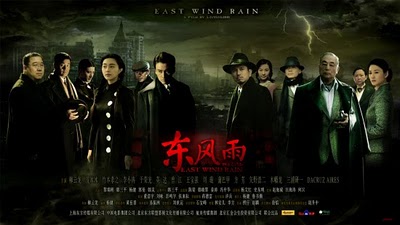
East Wind, Rain poster

Shanghai, the movie is not the only large scale movie based on this period. “East Wind, Rain” also takes place in the same background, with spies acting betwen Kuomintang and the Japanese army. The 4 minutes long introduction session is superb, including the re-created dog race just like that one that existed in the French Concession on Rue Cardinal Mercier (Now Shaanxi lu, the building was used as a flower market until being teared down a few years ago). A lot of attention was given to make the movie look good, however the action is far to slow not making the movie really interesting beyond the pretty introductory scene. As a movie, Shanghai is just so much better.

Deda Cafe

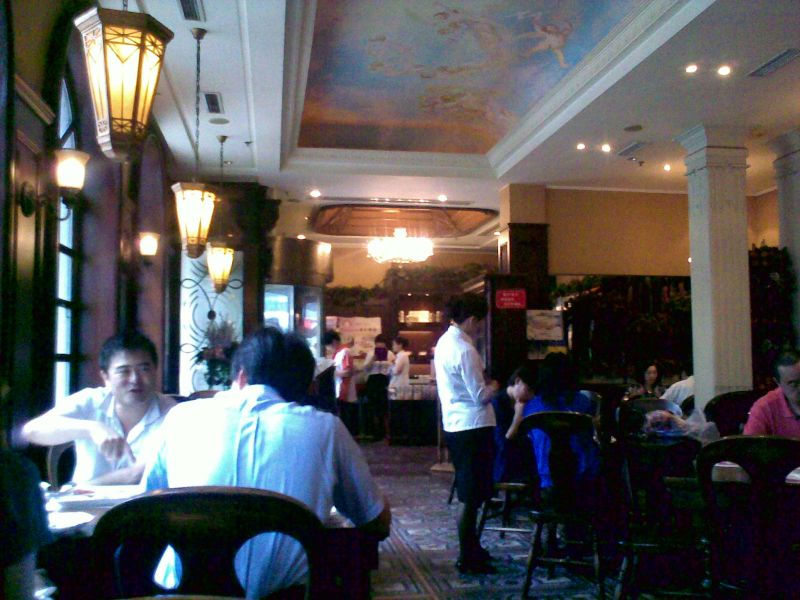
Deda's interior
Deda’s interior

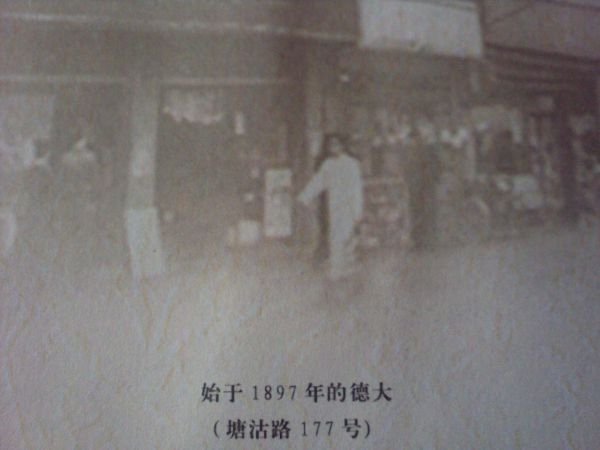
After being badly damaged by transformation, the facade of 473 Nanjing Xi Lu found back some of its old grandeur when Deda restaurant took this spot. Although operating in this location since only 2007, Deda is a Shanghai landmark. Originally opened in 1897 on 177 Tang Gu Lu in Hongkou district, the restaurant has survived through all the turmoils of Shanghai history.  The most well known one was surely the previous one on 359 SiChuan Bei lu, where the restaurant relocated in 1949.

The International Settlement and the French Concession had many restaurants, bakeries and coffee houses (See post ‘First Russian bakery and Tkachenko‘ ). Many of them were operated by foreigners, in particular Russians. As a matter of fact today’s Deda menu still has Borsch soup and potato salad coming with all set menus as well as a lot of deep fried dishes often found on the menu in Eastern Europe restaurants. The most amazing is not that the restaurant was opened such a long time ago, but that it has survived all the turmoils of Shanghai history since 1949. For generations of Shanghainese, Deda was a symbol of foreign culture and influence in the city. Although today’s menu does not compare with fancy new foreign restaurants, price is also much lower with lunch menus around 35 RMB.

Deda's first location
Deda’s first location

Today’s Deda main location on Nanjing Xi Lu is not an original old restaurant, but the renovation and design gives it a strong history feeling. Inspiration came more from early 1900 neo classic than 1930’s art deco but the whole atmosphere gets it right. Most patrons are Shanghainese regulars coming for nostalgia. Frozen through time Deda is like a re-interpretation of old Shanghai, on the Chinese side. There is a clear western influence but Chinese taste has also slipped through it, like the fried rice served with most dishes. The restaurant also includes a cake shop, another proof of survival of foreign cooking culture in Shanghai. The recipes have traveled through time, creating a mix of Central European sponge cakes and French tarts. Although quality is not on par with new stars of French patisserie like Paul price is also unbeatable with a slice of cake costing less than 5 RMB.

Seating in the coffee house by the window on Nanjing Xi Lu, I can also feel the vibrations of the metro line just below… just like similar vibrations of the tramway lines that used to run the same street in the 1930’s. Coffee drinking in Shanghai and coffee houses have a long tradition (see post ‘Shanghai Coffee Culture‘ on the topic) and sitting in Deda reminds me of coffee houses in Prague, Budapest or other cities in Central Europe. With its mix of Western influence and Shanghainese patrons Deda is just like a picture of Shanghai, a great mix of western and Chinese, modern and old at the same time, a true Shanghai institution.