Wukang Lu Tourist Information Center

The Wukang Lu Tourist Information Center has been open for a few years now, and somehow always escaped me. Located on a tree lined street typical of the former French Concession, it would have been the perfect place to show people what this area was at the time it was created and how it compared to today’s transformation in the Shanghai equivalent to New York’s Greenwich Village, or Paris, Saint-Germain. Although it’s a nice effort from Xu Hui district, it still felt short of my expectations.
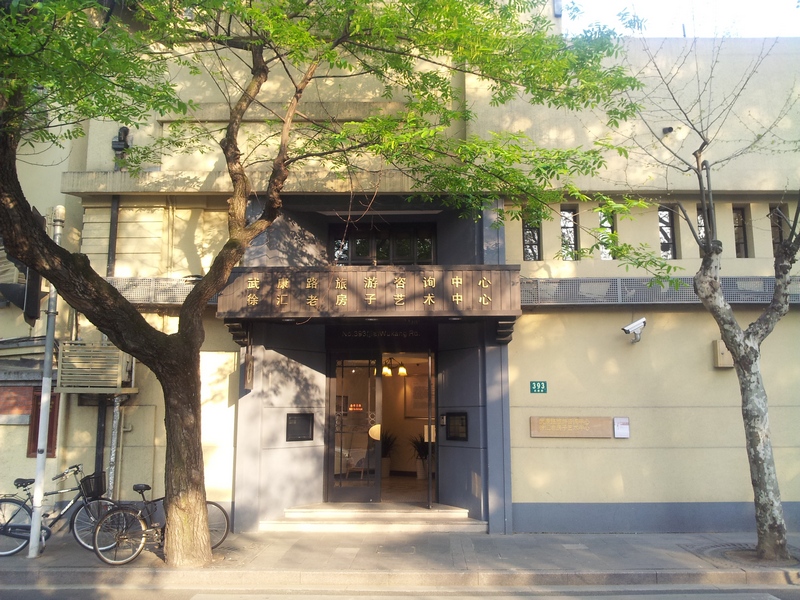
Wukang Lu 393
Wukang Lu Tourist Center Entrance

As the name says, it is a tourist center, not a museum. Located in a 1912 building, it includes a number of fake art deco fixtures (also called fako, see post “the rise of fako“). The result of a strangely shaped building with a mix and (not) match of decoration from architecture style is a little strange but not uncommon in today’s China. Models of buildings on display are really nice. They are some masterpieces of the area and this presentation really shows them in original state.

Model of building in Xu Hui
Model of the Normandy building in Xu Hui

What is really weird is that no reference is made to past names, usage or inhabitants of those buildings, nor is there any pictures displayed. It’s like this part of the city suddenly jumped out of nowhere, that the past never existed. At the same time, there is lot’s of space for today’s picture of the district and its various bars and restaurants, mixing old and new buildings without any regard for architecture style or time period. Just like inofficial books about Old Shanghai like “Classical Buildings of Old Shanghai“, no information is given to about the past times that created this very special part of the city.

Fako decoration
Fako decoration

Instead of a source of information to understand and appreciate the history of the area, we get an empty shell with little interest. This even more surprising as Wukang Lu has been the first (and only) place in Shanghai, to display the former name of the street as well as extra information of the buildings in the area (see post “What’s in a name“). The same space was used a few months later, for the Normandy building VR exhibition.

Shanghailander articles are published on an irregular basis. To be notified when a new article is posted, subscribe to the newsletter using this link, or follow the Shanghailander Facebook page

The Blue Lotus

Original album cover

“The Blue Lotus”, Tintin’s adventures in China, was probably the first thing I learned about Shanghai. The reality of today’s city has little to do with this cartoon anymore, but the book was an inspiration to come to Shanghai for many of us. Although it was a work of fiction, this great depiction of the city’s past still has find echoes in shikumens or villas in the former French Concession.

The weekly black & white cartoons were originally published in children weekly supplement of Brussels’ daily news paper “twentith century” (‘Le Vingtième siècle”). Famous cartoonist Hergé set to send his report to China for his fifth adventure. Rarely leaving Brussels, he started deep researches on this country that he knew little about. His meeting with a young Chinese art student in Brussels created the elements for his new work.

Zhang Chongren
Zhang Chongren

Born in Shanghai, Tchang Tchong-jen (Zhang Chong Ren in modern pinyin) studied painting in Tu Shan Wan art academy, that was founded by Jesuits priest in Xu Jia Hui. He was the nephew of Ma Xiang Bo (known in the west at Father Joseph Ma), a professor at Aurora University (run by the Jesuits brothers), who left it to start Fudan University. Just like many young Chinese, Tchang is highly interested in politics and wishes the end of the foreign concessions in China. He leaves China to Belgium on 23 rd September 1927, the day of the “Mukhden incident”, first step of the Japanese invasion of Manchuria and meets Hergé during the early part of his stay.

Tintin_006Tchang’s role in creating the cartoons really develops when Tintin reaches Shanghai. Being himself an artist, he strongly influences the drawing of the cartoon, making it so vivid that Hergé’s drawing sometimes looks like old photos of Shanghai.

Chinese characters used in the action and decors must have been drawn by him, including a number of secret messages, like political slogan demanding foreigners to leave China disguised as writing on walls. Some foreigners in the cartoon are seen as racists, exploiting poor Chinese people. Real pieces of news such as the “Mukhden Incident” are included in the story. Tchang is himself represented in the album as Tintin’s friend Tchang, demonstrating the link created between the two artists. Although this a biased view of a much more complex reality, the album carries the atmosphere of Shanghai at this period really well.

Having being instrumental in the cartoon creation, Tchang goes back to China in 1935, before the actual publication of the cartoon in “Le Petit Vingtième” newspaper. Having lost track because of the war and political events, Hergé will look for his friend for years, before finally meeting again in1981. The Blue Lotus remains one of the most wellknown Tintin album, having been published in several editions in France / Belgium and in China. Publication will be studied in a further post.