Cité Bourgogne, Shanghai

As a long term Shanghai resident originally from Burgundy I have been asked and puzzled about Shanghai Cité Bourgogne. Here is the story of this icon of Old Shanghai.

Like many people, I first got to know about Cité Bourgogne when I walked the streets of Shanghai, specifically the corner of Shaanxi lu (Avenue du Roi Albert) and Jian Guo Lu (Route Frelupt). Although not far Avenue Joffre (today Huai Hai lu Zhong lu), the main road of the former French Concession, this area was considered out of the city center in the early 1930s.
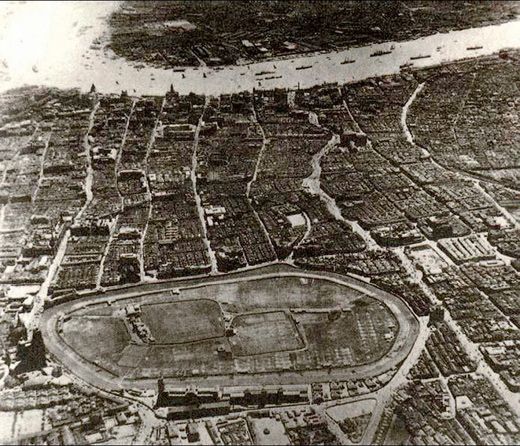
Aerial view of central Shanghai in the 1930s

Shanghai is famous of its rows of back alleys lined by brick houses. These alleys are called “Lane” in English, “Li Long” 里弄 in Chinese and “Passage” in French. They form a maze of tranquility and coziness away from the noise and activity of Shanghai streets. Houses lining the alleys are mostly Shi Ku Men 石库门, named after the stone door frame closing the courtyard and facing the alley. Housing style evolved with time and wealth, from tiny houses to small mansions. As seen on above picture, most of old Shanghai used to be covered with lanes, the most common accommodation for Shanghainese in the 1930s, as shown on above picture. Cité Bourgogne is mostly noticeable because of its name.
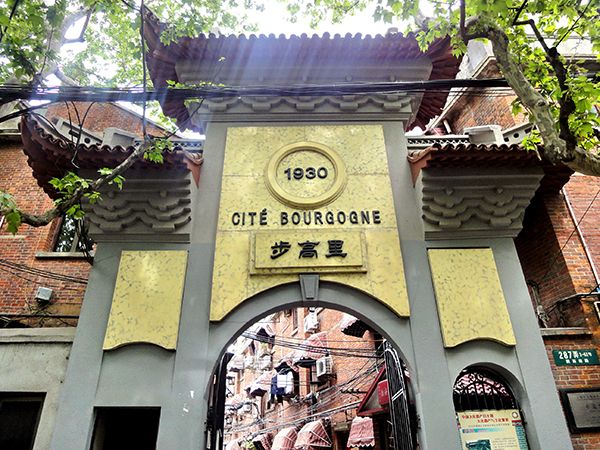
Cité Bourgogne entrance on Shaanxi Nan Lu

If most Lilong had entrances marking the name of the `lilong in Chinese, this one is really special. Designed in Chinese revival style, it indicates the year of completion of Cité Bourgogne, 1930. Below it is the name “CITÉ BOURGOGNE” and the Chinese name 步高里  / Bù Gāo Lǐ. This is different from the original layout shown below, where only the Chinese name was written. The (fake) yellow stone and new indication was probably more recently, during a renovation. The good thing is that it attracts attention.
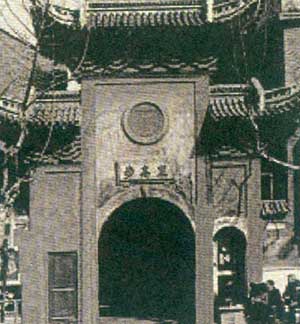
Cité Bourgogne originale façade

The lilong or lane in English has 78 houses, each of which were originally occupied by one family. As the house were quite large, it was clearly an upmarket residence. The houses were later subdivided and about 450 families now live in Cité Bourgogne. The location at the corner of Avenue du Roy Albert (today Shaanxi Nan lu / 陕西南路)and Route Frelupt (Jianguo Xi Lu / 建国西路) was on the edge of the urban area of the former French Concession, away from the city center. On the other side of Route Frelupt (Jianguo Xi Lu / 建国西路) was located the French shooting range, where Luwan stadium now stands. At that time, it was the South edge of the built area of the French Concession. A block further down was the Zhoajiabang creek, 肇嘉浜, the administrative border of the French Concession.
Cité Bourgogne Entrance on Jiang Guo Xi Lu

Cité Bourgogne was the property of real estate developper “Foncière et Immobilière de Chine” or FONCIM. This company was the real estate arm of ISS, an insurance company and one of the major French company in Shanghai then. It is mostly famous for its Art Deco building designed by LVK, including the Dauphiné, the Gascogne and many more. However, FONCIM also had a number of lilong including Cité Bourgogne, and 建业里 / Jian Ye Li that is now the Capella Hotel further on Jian Guo Xi Lu.

Although FONCIM used LVK for many of its buildings, it is not clear that they used them for Cité Bourgogne. It was clearly not the case for its other lilongs. Cité Bourgogne modern Shikumen style could fit LVK style, but the project is not mentioned in the 1934 14th July double page ad in Le Journal de Shanghai, showcasing the work of the firm over the period. I have seen secondary sources mentioning LVK as the designer, but no proof so far.

This lilong differs from many other with its archway towering the alleys, making is really memorable.
Archways of Cité Bourgogne

FONCIM had the habit of naming its buildings after French regions. Its buildings were named Le Béarn, le Dauphin´´e, Le Normandie, Le Picardie, Le Gascogne. Thus us is not surprising to have an another property called Cité Bourgogne.
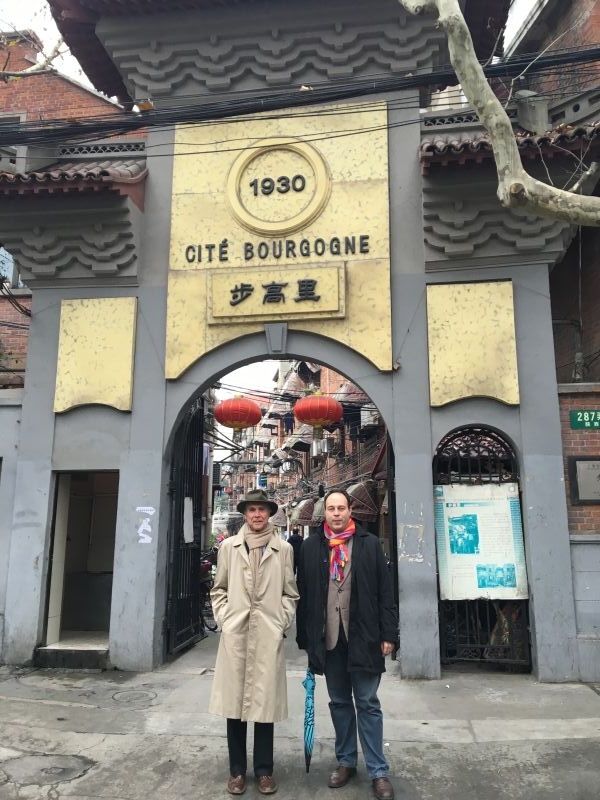
Cité Bourgogne with Aubert de Villaine.

I could not find a real link with the actual region of Bourgogne in France. nor with its wine that were sold in Shanghai at the time. However, since the name is so visible, people from Burgundy regularly ask about a possible link with the region. I even had the privilege to take the most famous Burgundy winemaker, Mr Aubert de Villaine, owner of the Word famous Romanée-Conti, for a tour to Cité Bourgogne. As a true Burgundian, I also made some research about Burgundy wines in Old Shanghai a few years ago, but not link came out between Cité Bourgogne and Bourgogne wine either.

Shanghailander articles are published on an irregular basis. To be notified when a new article is posted, subscribe to the newsletter using this link, or follow the Shanghailander Facebook page.
Burgundy wines in Old Shanghai

The previous post was about wine import in 1920-1930s Shanghai (see post French wines in Old Shanghai for details). France was the largest provider for imported wine. Being orginally from Burgundy, I did some research into this specific region that was then famous for its wines and is even more famous today.

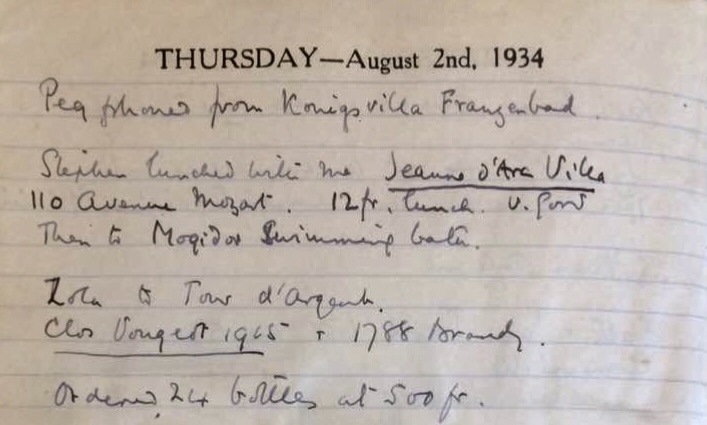
Burgundy wines where famous among the elite in 1920s and 1930s Shanghai. The most famous person drinking Burgundy wine was surely Sir Victor Sassoon, owner of the Sassoon house hosting the World famous Cathay hotel and many other buildings in Shanghai. Sir Victor Sassoon wrote a journal and during a trip to France on 2nd August 1934, he had diner as leading Paris restaurant La Tour d’Argent where he was served Clos Vougeot 1925. He must have really liked it as it ordered 24 bottles of it and probably took them to Shanghai.

Journal of Victor Sasson, 2nd Aug 1934 (picture courtesy of Didier Pujol)

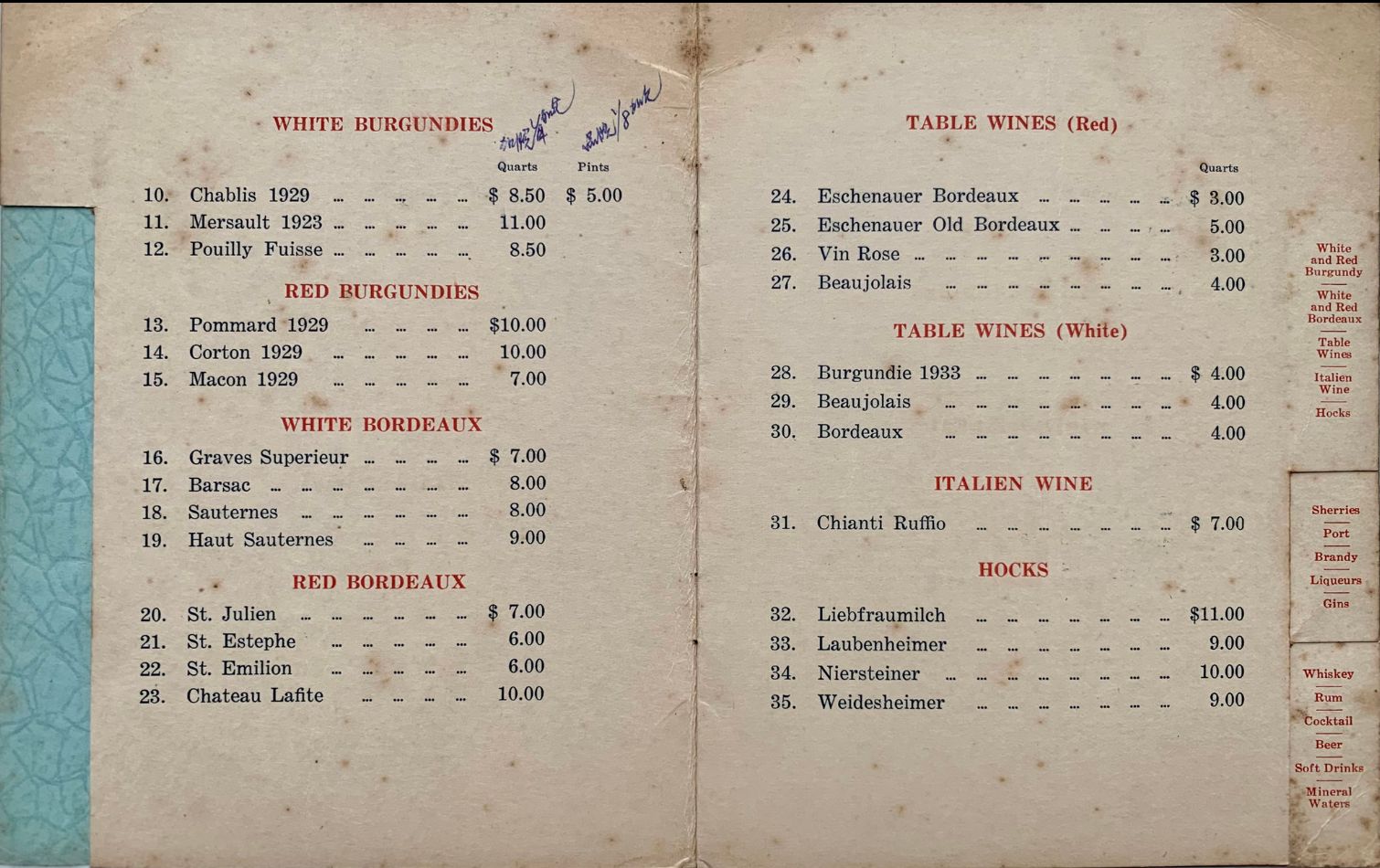
As shown in previous post, 1939 wine list of famous Sun sun department store Sky Terrace included Burgundy whites such as Chablis 1929, Meursault 1923 (with a spelling mistake) and Pouilly-Fuissé. Burgundy red were Pommard 1929, Corton 1929 and Macon 1929. It has to be noticed that 10 years old wines were sold and served in restaurants. Even the Burgundy white table wine was from 1933, i.e. 6 years old. Burgundy wines at that time were kept for years before being drunk. Although they still can be kept for decades is properly stored, they are often drunk much younger now. It is noticeable that Burgundy wines were more expensive than Bordeaux at that time in Shanghai.

Wine list from the Sky Terrace Restaurant of the Sun Sun department store, late 1930s (Courtesy of MOFBA)

Some Burgundy houses tried to get into the Asian market using the French colonies as a springboard in the early 1920s until the mid 1930s. While Indochina (today Vietnam, Cambodia and Laos) was the largest area controlled by French in Asia, China with its large population was the main target. In a way similar to today, wine houses had agents in Shanghai that would purchase the wines and resell it being both importers and distributors.

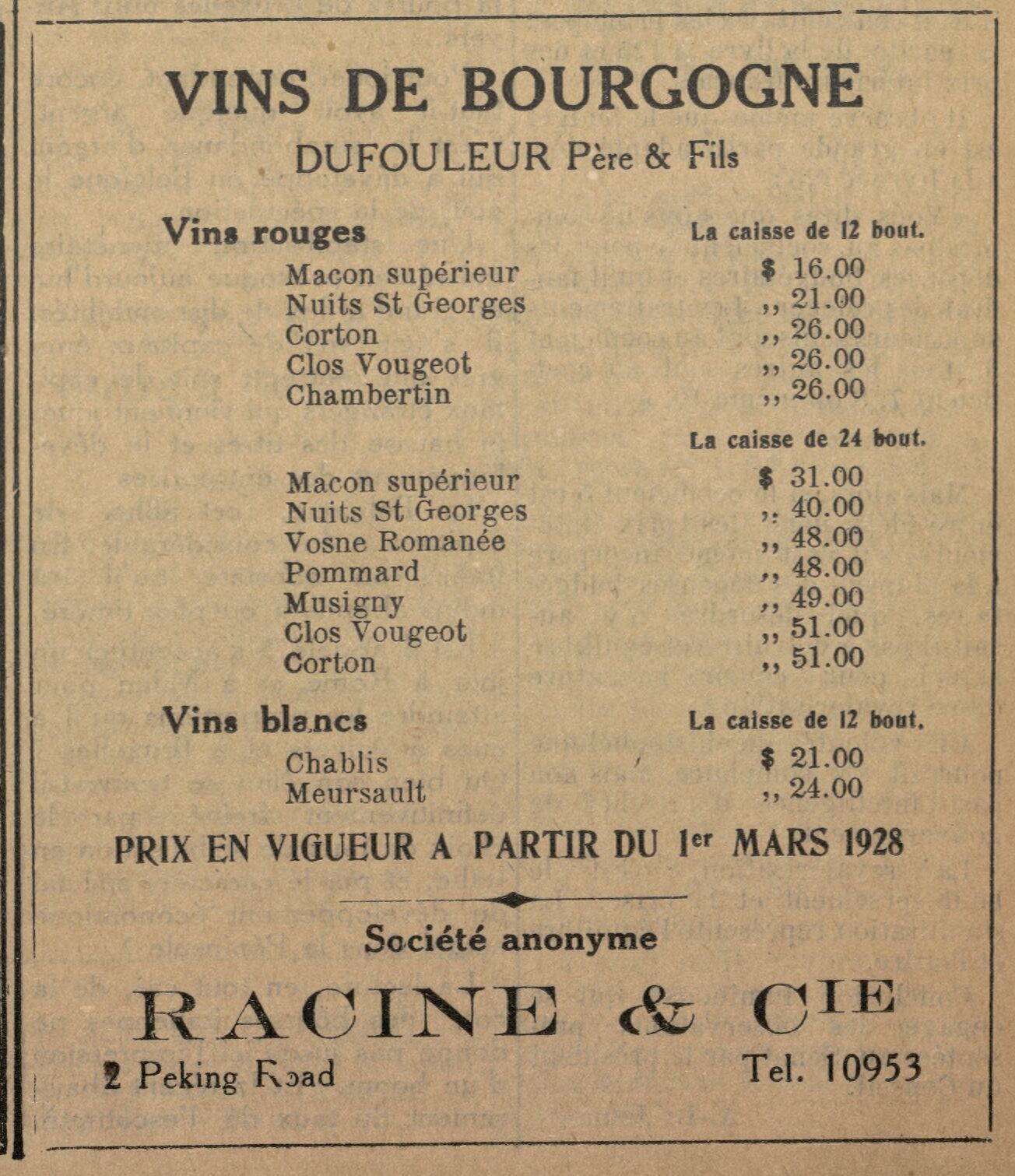
Dufouleur wine list, Racine & Cie 1928

French wine in bottles was mostly handled by French people. Just like today, major trading companies imported wines in their portfolio. Above picture shows an add for wine from Dufouleur, a wine house in Nuits-Saint-Georges that is still making wines today. Their wines were imported and distributed by Racine & Cie, one of the major French trading company in Shanghai that also advertised for imported canned vegetables (see post Vegs in a can for further details).

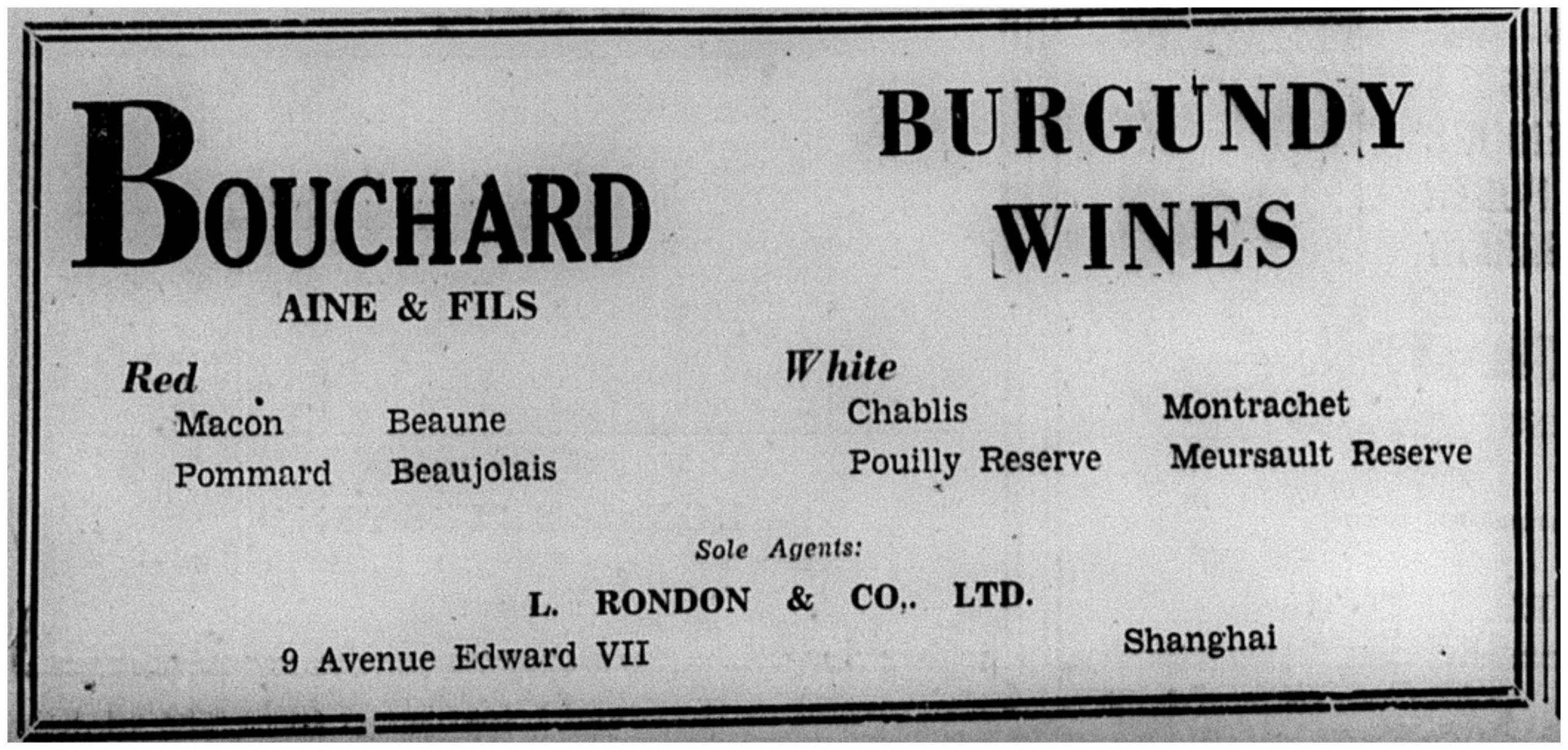
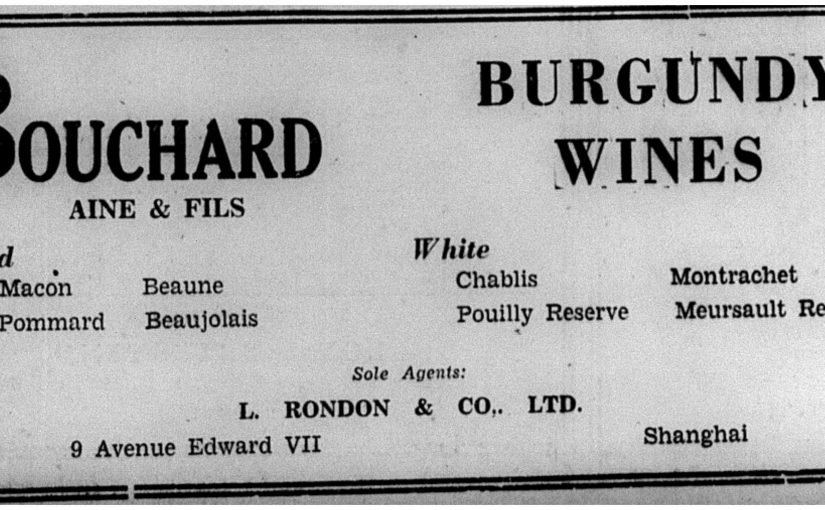
Add for Bouchard Aine wines in Shanghai. L Rondon & Co was the agent

In the same way, smaller import company Rondon was the sole agent for large wine maker and trader, or “négociant” in French, Bouchard Ainé. They already had large range of Burgundy wines imported in Shanghai by agents L. Rondon & Co. Now property of Burgundy wine power house Jean-Claude Boisset, Bouchard Ainé has been back in today’s China since the early 2000.

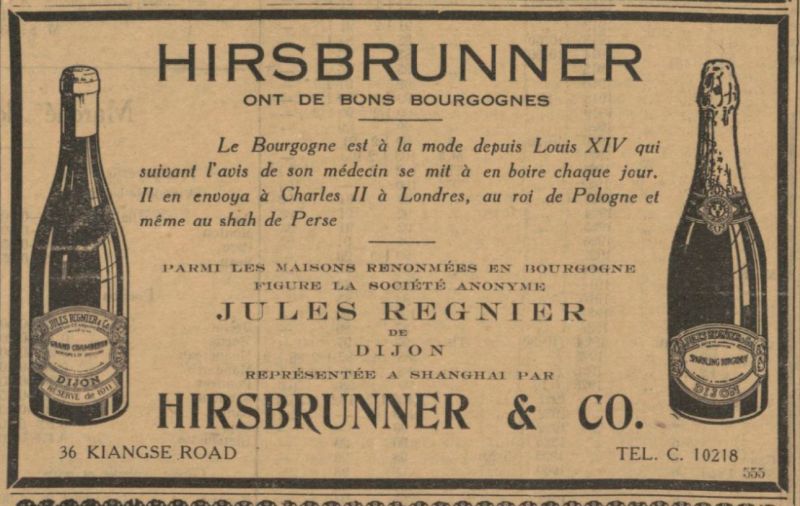
Ad for Jules Régnier wines, imported by Hirsbrunner in Shanghai, Journal de Shanghai Mai 1928

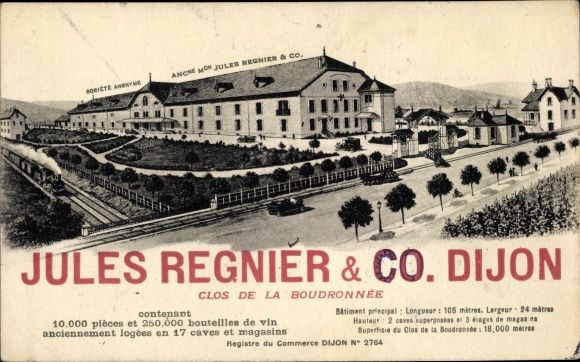
Trading company Hirsbrunner was the importer of négociant Jules Regnier. Their ads in the press were more interesting than an simple list of wines as they also tried to link their wines with history. The bottled displayed were Grand Chambertin and sparking Burgundy. Jules Régnier & Co does not exist anymore, but I found a picture of their cellar and heaquarters in Dijon.

Burgundy wine history was studied in depth by French scholar Christophe Lucand, who is also the Mayor of Gevrey-Chambertin, one the famous Burgundy village and my home town. While Indochina (today Vietnam, Cambodia and Laos) was the largest area controlled by French in Asia, China with its large number of people was the main target. Just like many other manufacturers in Europe and the US, Burgundy winemakers dreamed of having millions of Chinese drinking their wines sending back huge profit. Burgundy wine makers where by far not the only ones having this dream and similar stories are told in fantastic Carl Crow’s book “400 customers”.

Converting large number of Chinese to drink wine was a complete failure and the effort to bring Burgundy wine to China ended in the mid 1930s. Still, foreigners in China’s concession as well as elite Chinese seemed to have enjoyed those wines a lot. It took another 90 years for Burgundy wines to become famous in China, where they now are the darling of wine lovers imported by numerous trading companies.

More information about wine import in old Shanghai can be found in post French wine in Old Shanghai.