This post is not strictly about Shanghai, but about its little less known sister, TianJin. Shanghai colonial is well known, researched and documented… but it was not the only treaty port. Along the Chinese coast other international concessions were built on with foreign buildings, including ShaMienDao (Guangzhou), GuLanYu (Xiamen), Qingdao (old German colony) and Tianjin (Tientsin). Tianjin was surely the most developed of the treaty ports after Shanghai, having been the location for up to 8 concessions (French, English, German, American, Austrian-Hungarian, Russian, Belgian and Italian). I had always heard that very little remain of the old buildings until a friend actually went there and took a tour. In fact, although quite a bit has been destroyed, the Tianjin municipality is doing a great job at keeping and restoring the remains. The most amazing part is probably the Italian concession.
The Italian concession was created in 1902 and is probably the only Italian colony in Asia. It was located on the North side of the Hai He river, between the Russian one and the Austrian-Hungarian one, connected with the French concession by the “International Bridge”. The main attraction is Piazza Regina Elena (earlier named Piazza Marco Polo) and the surrounding streets. The area is a gem as most building are now restored in their original state. It was described as bustling with life and noise before 1949 and was surely overpopulated afterwards, but it is now deserted. The renovation project was supposed to come along with an Italian-Chinese touristic development. Renovation was done by the Chinese part, but the Italian partners seem to have disappeared. The Sunday we were there, streets were empty apart from the occasional car and the weather was really hot. Looking at the statue on Piazza Marco Polo, it felt like we were enjoying the hot summer in a small town in Italy, thousand miles away from China.
Having walked through the English and French concession to reach the Piazza, we were dreaming of pizza and ice cream looking at this Italian ghost town in China. The wait was not in vain, since an Italian restaurant has opened its door in one of the villas around the plaza. “Buitoni’s” chef probably never went near a real Italian dish judging by the poor quality of the pizza. However, along with a nice gelato and an espresso, it just did the trick. It was the perfect end for our short trip to this little piece of Italy in China.
 I looked into the “bakery” entry of this older version of the phone book and found out 15 entries. I remember reading that the bakery business in the 30’s was run by many Russians in Shanghai. By looking at the names of the shop, at least 5 of them were run by Russians. The most obvious was First Russian bakery, Tchakalian (more about in a further post) and Tkachenko.
 First Russian bakery is pictured right (picture is from the website of the Shanghai municipal archives). Located on 234-
 236 Avenue du Roi Albert (This now Shanxi Nan Lu, the location was approximately opposite Parkson on the other side of Shanxi Nan Lu). This was the urban art of the French Concession where many small apartment buildings were built, not far from
 Tkachenko bakery was also pictured on the same website.

 Going to antic markets is always like a treasure hunt. Finding things is a matter of luck, but also of knowledge. The best example is surely this little envelop that I found last week. I had seen it before but never really noticed it. It’s a pretty banal object, a envelop for a drawing tool that came with it. It has become grey with time and usage but the prints are still clearly visible. The ruler in it is still stainless and nearly as new (see picture below).
 This is typical of the the Shanghai style, or Haipai. At written on the envelop, the ruler was made by a Shanghai company. It is a simple drawing tool, an industrial mass consumption product but the envelop design really gave it a very modern look for the time. Along with the “International Brand” ( with the logo with plane and earth), the design gave the impression to the buyer that he was getting a piece of this bright new world on display in magazines and posters. Haipai styling was not limited to newspapers, books and other intellectual objects but also also applied to more usual objects, making them truly Shanghainese. This simple object is a true reflection of Shanghai at that time, a true Shanghai product.


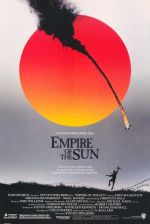 I remember the movie’s poster when it came out in 1987. Steven Spielberg was already famous, though not the star that he is now but the movie was much talked about. I did not see it then, and it’s only recently that I realized its connection with old Shanghai.