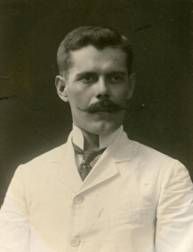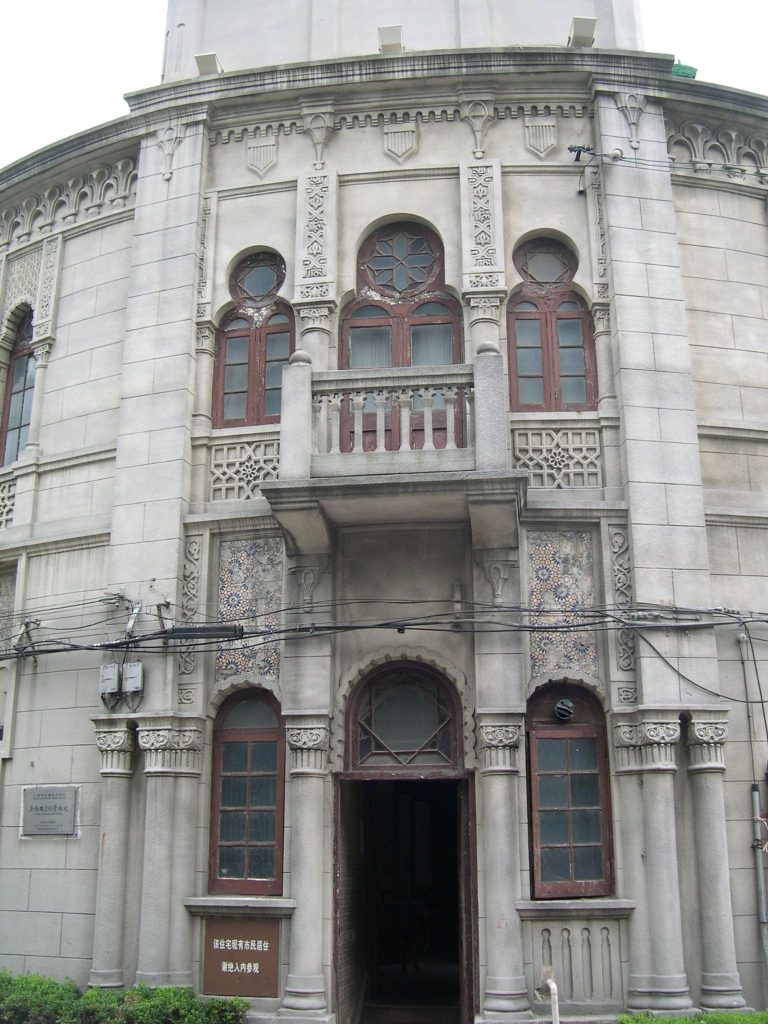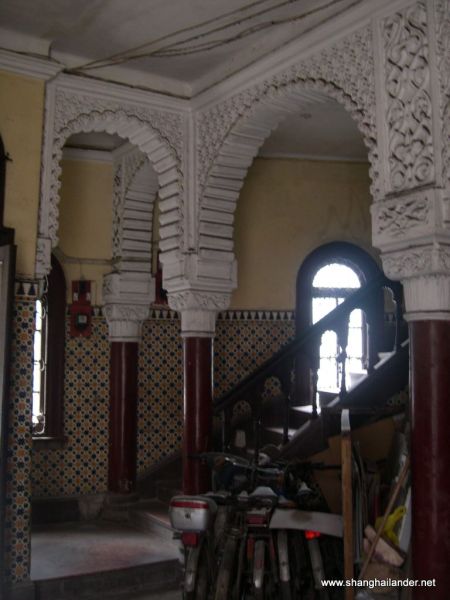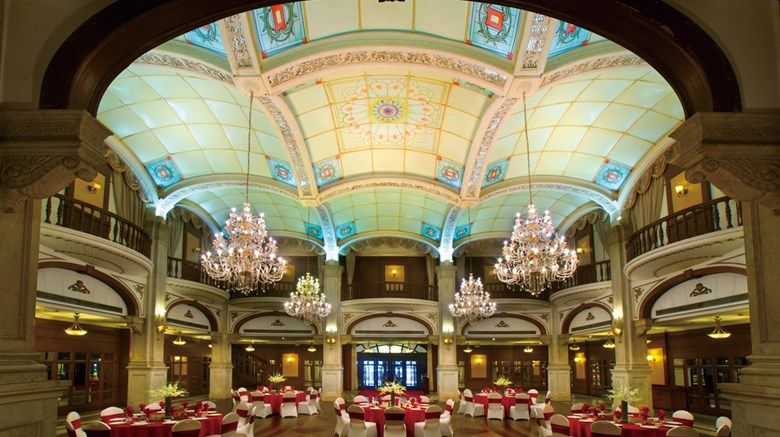
I mentioned Saint-John University in earlier posts. Another famous alumni of the main University of Old Shanghai is Zhou Youguang, the man who invented Pinyin. Born in 1906, he went to the US to work as a Wall Street Banker after graduation. Returning to China after 1949, he lead the committee that created Pinyin, introduced to school in China 1958. The most incredible is that is still alive and writing is own blog on Weibo (in Chinese only).
Imported foreign food in today’s Shanghai is still an essential support for foreigners living in the city. In the nearly 8 years since I have been in the city, local alternatives have been developped but they are rarely matching the original. Moreover, as the foreign communities grows and grows and more and more Chinese people like foreign dishes, import of foreign food is constantly growing. Modern transportation allows to fly in fresh products kept at constant temperature, making possible eating French oysters, Australian yogurts and New Zealand Kiwis in Shanghai.
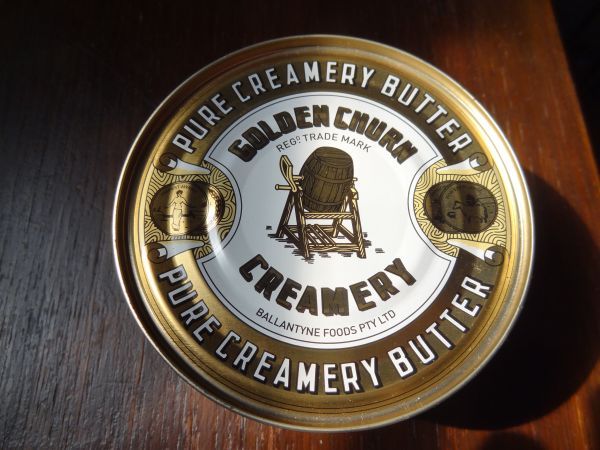
Butter in a tin… like in the old time
Old Shanghai consumers of foreign foods did not enjoy such luxury. With the mother land weeks away on a cargo ship, food had to be preserved through various means for transportation. One of the most fragile type of products was dairy that does not keep long, even within a fridge. Above image is a picture of a modern tin of butter that I bought in New Zealand in 2010. Although butter is now mostly imported fresh in controlled temperature, preservation in tins was the only way to bring butter all the way to Old Shanghai. I have to admit that I was quite surprised to find this one, but it seems to be still selling. Butter is used a lot for western cooking, so large quantities of butter were imported in Shanghai. The 1934 “Trade of China” shows that 701,6 tonnes of butters were imported in China in 1933 and 746 in 1934. They were mostly imported through the ports Shanghai and Tianjin, mainly from Australia… and New Zealand.
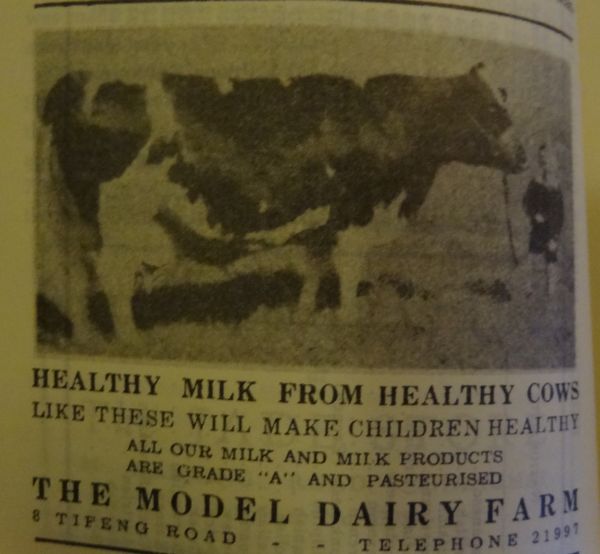
advertising for Model Dairy Farm
Local farms also produced milk and milk products, as advertised on several pages of “All about Shanghai and its environs” including picture left. There was quite a number of dairy farms in today North Jing An district, in particular today’s Yan Ping Lu. The daily milk delivery system (like in the UK) is still in place in the old parts of the city center, though it is not much used anymore. In 1937, there was 10 dairy farms in the classified section of the Shanghai Dollar Directory, the local yellow pages. Just like today, local production was far from satisfying demand.
For transportation, milked was condensed and sweetened before being canned. Condensed milk can still be found in China, though it is more a delicacy than a main food ingredient. However, like in Hong Kong, Vietnam or Malaysia today, condensed milk was clearly a common product in old Shanghai. One of the major company importing condensed milk then was Nestle, already having established presence in old shanghai. 2,229.8 tonnes of condensed milk was imported in China in 1933 and 2,515.5 in 1934 mostly from the USA, The Netherlands and Switzerland.
For more on milk supply in Shanghai, go to post « Shanghai milkman ».
Old Shanghai was a major touristic attraction. Although international travel at the pace of cruse ships and hydroplanes was much slower than in today’s jet age (see posts “No Flight to Shanghai” and “Two months in rationnaire“), hotels of all categories where numerous then. A number of them have now been renovated, like the Cathay Hotel (see post “Return to the Sassoon House“) or created from Shanghai old monuments (see post “Shanghai Club revival“). One of the less wellknown is the Yangtze Hotel, currently the Langham Yangtze Hotel.
Yangtze Hotel, Hankou Road
Yangtze hotel was planned in 1932 in a plot next to the newly built Moore Church designed by László Hudec. Near the Shanghai race course and Nanjing Road shopping street, the hotel was located in the entertainment area of the International Settlement. Designed by Chinese architect Paul Lin Pan 李蟠, the hotel was built by Pan Shang Lin 潘尚林 building firm. The same firm, who belonged to the family of famous Old Shanghai author Lynn Pan, also built major landmark of the period including Park Hotel on People Square, Picardie Hotel on Heng Shan Road and the head quarters of Bank of China on the Bund. The hotel external design is one the best examples of Art Deco architecture in Shanghai. Balconies in particular were decorated in the famous “Zig Zag Style” complementing the geometrical feel of the whole construction. Although is the middle of the city, it is less noticed at the corner of Hankou Lu and Yunnan lu, both one way streets away from it.
With is very modern design and location in the heart of the entertainment district, the Yangtze hotel quickly became the favorite of the entertainment crowd. The Great World entertainment center (corner of Xizang Lu and Yannan Lu) was only a few steps away, along with the theaters in the area. The hotel was also very close to the shopping mecca of Nanking Road, with Wing On department store among others. Finally, it was also very close to the race course as well as theaters such as the Grand Theater and the Metropole Theater. The Yangtze Hotel attracted Chinese celebrities, coming to dance on it’s famous spring wood dance floor in the Yangtze Ballroom. It was home to the first all Chinese Jazz Band, the Clear Wind Jazz Band. It’s resident singer was the legendary Yao Li who is most famous for the song “Rose, Rose I love you”.
1930’s luggage label, Yangtze hotel, Shanghai
The hotel produced luggage labels like the one above in Art Deco style, perfectly fitting the hotel’s design and time period. I particularly like the Art Deco Chinese characters designs. Hotel luggage labels have long disappeared along with the attraction of the Yangtze Hotel for Chinese celebrities.
The interior of the hotel was ruinovated in the 1980’s and 1990’s in an effort to modernize it. It was used as a cheap hostel, like its sister hotel the Astor House on the North Bund. Original decoration including the famous spring wood floor was lost forever. From 2007, the hotel was renovated to put it to high level standard. Although not the original one, the current decoration is Art Deco inspired with a grand staircase and a stained glass ceiling similar to the ones of the time, like in the Cathay Hotel. With its new renovation the hotel still has a lot of charm both outside and inside, making it a nice place to stay in the middle of the city, but away from the modern hotels towers nearby, like a little time travel to Old Shanghai.
In the recent post “Shanghai exiles“, I mentioned our meeting with Isabelle and Raymond Chao. Isabelle talked about a friend who owned a Harley Davidson in late 1940’s Shanghai. As I regularly drive up the Bund with my 1930’s sidecar replica, I could relate to this very well although I did not see any picture then. It’s a few weeks later that I received the enclosed picture. This is Isabelle on the Harley-Davidson in Shanghai, around 1948, a very different look from her picture on the above mentioned post. With sun glasses and leather jacket, there is something really cool about this picture. This is one of he quintessentially American looks later seen the 1955 James Dean’s “Rebel without a cause”, or 1980’s Indiana Jones series.
Harley Davidson FL 1947
After some research, I guess this motorbike was a Harley Davidson FL. Picture left is 1947 model, 1948 was very similar. The V-shaped twin cylinder 1200cc 51 HP engine is very different from the 750 flat boxer engin on the 1938 BMW R71 that was the original master for my Chang Jiang sidecar. However, the period look of the Harley has similarities with the BMW one and I am sure the feeling driving it down the Bund must not be very different.
Doisneau’s motocyclistes
Isabel’s picture also reminded me of one of my favorite motorbike picture, Robert Doisneau “Les motocyclistes”, shot in Paris in 1953. Although both pictures have a similar feel and were taken only 5 years apart, at that time Old Shanghai had already ceased to exist.
Shanghai’s history has often been quite tormented and street names have been changed often. Old Shanghai enthusiasts (like me) can sometimes be heard talking about the old names of current Shanghai streets, including Avenue Joffre, Hart Road or Avenue Edouard VII. Shanghai streets grew with the city itself, following its transformation. Foreigners came in, created concession and settlements then went away, leaving their mark on the street names. The Communist “Liberation” and its ideology came and most of names where changed. This is when the Avenue Joffre (one of the main general of the French army in World War I, a very common street name in France), was turned to Huai Hai Lu, the major communist victory against the nationalist Guomintang army in 1948-1949. This is also when Avenue Edward VII (British King Son of Queen Victoria who died in 1910)/ Avenue Foch (another French general from World War I), was turned in Yan An lu (the place in Shaanxi province where the long march finished).
The name of the original streets of the international settlement perpendicular to the Bund like “Da Ma Lu” (today Nanjing Dong Lu) and Si Ma Lu (todays Fuzhou Lu) were changed into names of cities and provinces of China, and later other Asian cities (like Singapore and Penang Road). They also included a few local celebrities (like Hart Road and Gordon Road). Streets in the French concession were mostly named after local French officials and celebrities, like Route Vallon (today’s Nanchang Lu) named after the French aviator who flew the first airplane in China… and crashed People Square in 1916. Apart from the foreign names, Shanghai streets also had Chinese names sometimes similar to the foreign one like Sinnan lu (Rue Massenet in French), Gaohan Lu (Route Cohen in French), Sha Fei Lu (Avenue Joffre in French). Sometimes the name was totally different and often much more practical, such as “Bubbling Well Road” (current Nanjing Xi Lu), named after the bubbling water spring that was located near today’s Jin An Temple. It’s Chinese name was simply “Jing An Si lu”, i.e. Jing An Temple street.
Old street names and new ones on Wukang Lu
I have long dreamed that old street names would be displayed back on Shanghai street. Some attempts were made on private buildings like “Rue Francis Garnier” on the bakery on Dong Ping Lu, or the Henry’s restaurant on Route Paul Henry (today Xin Le Lu). The aim is obviously not to re-instate a long gone past, but to show the history of places, helping Shanghai to reconnect to its own. I am surely not the only one to have dreamed of this and somebody has actually done it. It is currently limited to one street, the current Wukang Lu, former Ferguson Road but this really looks like an official attempt. Hopefully, this will be extended all streets of Old Shanghai. Not sure how long it will take though.
Update 2025: Old Shanghai nostalgia has grown a lot among people, shown by events like the Shanghai Style fashion festival (See post “Night out at the French Club” for more details). However, official reference to old Shanghai street names never materialised.
When Georges Balfour, the first Consul in Shanghai arrived in 1843, after the signing of the treaty of Nanking, what is now the Bund was very different from today. The world Bund comes from colonial india, meaning a mud bank on a river. On those early days of Shanghai, this is just what the Bund was, a mud bank over the river.
Today’s view
The area of swamps between the Suzhou Creek and the filthy Yang Jin Bang (to be later covered and turned to Avenue Edward VII, or Yanan Lu today) was granted to the Brits to make their settlement. They had already realized the importance of the mouth of Suzhou Creek going into the Huangpu river as a strategical place, by being bombed from this point during an exploratory trip in 1832. Naturally, this crucial point became the ground of the HBM Consulate, representing the British Empire in Shanghai.
Left side of the consulate
The current building along with the consul residence next to it was completed in 1873. It is one of the oldest building on the Bund, having survived the various reconstructions of the area. It was used as the British Consulate until 1967, when the consular staff was chased out during the Cultural Revolution. It then became a friendship store, before being abandoned. One of the buildings in the compound (left on the period photo) has been knocked down to make way for the Peninsula hotel, but the rest of the compound has been skillfully renovated. The Park was open to the public at the beginning of 2011 and it is now possible to cross the former Consulate Park to reach Yuan Min Yuan Lu and the Rock Bund project, making it a really nice walk.
Entrance of today’s financiers Club
The external renovation has been very careful, keeping the original appearance of the building. It has been transformed into the “Financiers Club”, closed to the public so it is difficult to judge the internal renovation. The complex is managed by neighboring Peninsula hotel and used for functions. I heard one of the buildings will be transformed into luxury shopping center (what a surprise!). In any case, the renovation of the former British Consulate is quite a success, managing to preserve the atmosphere of one of the oldest remaining building of old Shanghai. Hopefully, many more will follow.
Raymond Chao & friends, Saint John University, Shanghai, late 1940’s
This blog has raised in popularity over the years and people from various places have been contacting me about it through the internet. However, one of the recent most interesting encounters was arranged through a friend of a friend. After a 2 hours conversation (originally planned for 1/2 an hour), Claire’s conclusion was “You definitely have to meet my parents. When are you going to Hong Kong?”. We just went to Hong Kong and met her parents. This post is the recollection of our conversation.
Isabel and Raymond were both born in Shanghai, “We both went to Saint John University” said Isabel. “I used to walk every day across Jessfield Park (today Zhongshan Park) to reach to it.” Having been to the old Saint John University (today Shanghai University of Law) only a few days ago, I showed them the pictures that they recognized instantly. “My high school was the Mc Tyeire school (today Shanghai number 3 girl school), on Edinburgh Road (today Jiangsu Lu). Then I went to Saint Mary school for high school. It was near Saint John University and was severely damaged during the Japanese occupation, so class took place in the one of the nearby Saint John University buildings”. As far as I know, the school does not exist anymore in that location, but it is quite vivid in Isabel memory. “We were living in a house on Yu Yuan lu, about half way between the Park and Jing An Temple. I could walk to school and later to University”. Raymond parents also lived in this part of the city, the extra-territorial roads, West of the international Settlement.
Isabelle Chao about the same period
Isabelle also asked whether we knew about Zhang Ailing’s works. “Zhang Ailing also went to Mc Tyre school, she was about 11 older than me. My life was actually quite similar to hers. My teachers were also her teachers, they also thought I would become a writer, unfortunately it did not happen. Maybe I was a bit more practical than she was”. “Shanghai was a happening city, I used to go to dance halls like to Paramount (corner of Hua Shan Lu and Yu Yuan Lu), or the Ciro’s (today disappeared, was located near people square). I used to go to the movie in the Cathay or the Grand Theater. I liked the Park hotel a lot, when I was in Shanghai I always thought it was so tall then, and now it is so small compared to other buildings.” (Park Hotel was the tallest building in Asia when it opened in 1934. It counts 25 floors. See post Advertising Park Hotel for more details). “I was only 19 when we left Shanghai in 1950 so I did not have so much time to enjoy it. When I was 17 years old, my first boyfriend was driving me around on his Harley-Davidson motorbike. We used to drive down the Bund and a lot of people were looking at us”. This is strangely echoing driving down today’s restored Bund on my own 1930’s sidecar motorbike. I am still amazed that Harley-Davidson motorbikes were imported then, as they only were imported again in China a couple of years ago. For more information about this, see the specific topic “Harley on the Bund“.
What Jiajia and I gathered is that Raymond and Isabel knew each other in Shanghai, but probably got married in Hong Kong. Coming from the same background, they probably left Shanghai around the same time, recreating their life in similar circles in their new home. Although they both speak Mandarin and Cantonese, they still speak to each other in an old fashion Shanghainese, similar to dialogues in the movie “in the mood for love“. Listening to them is sometimes reviving a past long gone, similar to the meeting with Liliane Willens a few years ago (see “a date with Liliane“). Isabel concluded our meeting with this sentence: “All these memories of the Shanghai I knew I always thought no-one would be telling them again, that they were forgotten forever. It amazing that some people are still interested in them and that they have been preserved.”
Update: I was very sad to learn that Raymond Chao has passed away on 8th May 2012, less than a year after this meeting took place.
Update: Isabel and Claire Chao have written together a book about the family life in Old Shanghai, “Remembering Shanghai”, published in 2017. Please see post for more details.
As the largest metropolis of China, Shanghai was the focus of development of modernity in China, including the development of Universities. Hidden behind Zhong Shang Park (the former Jessfield Park), in a curve of the Suzhou creek stands the old Saint John University, which used to be the most prestigious University in China. Today’s East China Institute of Politics and Law has kept most original buildings from the old times and is still a nice place for a short visit. The best way to access it is probably to walk through the park to reach its back entrance, although it is also possible to follow the Suzhou Creek.
Saint John University Reading Room
Saint John University was created in September 1879, it was created and supported by the American Anglican Church. The picture left is from 1907, showing one of the reading room. Religion had a strong importance in the teaching, and the university was lead for decades by clergyman Dr F.L. Hawks Pott who also wrote “a short history of Shanghai“. Under his governance, Saint John College became the leading University. Teaching was in English, a lot of faculty was foreign and modern education methods as well as sport took a great place. The University was modeled after the American University system and graduate students could be join American Universities for their post graduate studies, of few of them actually going to Harvard or Yale. Saint John University also formed the elite of China’s societies with many of them becoming high civil servants or joining Chinese and international companies after graduation.
Founding Stone
Architecture style of the university buildings have mostly been a mix of Chinese and western. They were actually often western buildings with a Chinese roof and decoration, similar to what was latter called Republican Architecture. As the University expanded, more buildings were created following the style of the time. The main building is much more of western style, quite similar to some of the buildings that were originally on the Bund, and the clock tower has been added later. Si Meng Hall near the River is also of a similar style, with all the original verandas having closed like in most old building in Shanghai. One the of really interesting one is on the right side towards the entrance. The style is clearly much later, probably late 1920’s early 1930’s as it is very similar to Jiangwan Shanghai Civic Center building. The founding stone of the Univeristy (marked 1879, picture left) is still visible. It seems to have been broken in pieces and put toghether later, probably during cultural revolution time.
Detached from the city and protected from noise by the park and the river, the campus feels like an oasis of quiet just a few minutes from busy ZhongShang Park Cross road, probably the most charming university of Shanghai.
Short trips to Hong Kong are often the opportunity for business meetings and intense shopping. Although a lot has been destroyed, there are a few places in Hong Kong that have historical interest. Below are a few points of interest:
Saint John Cathedral
St John Cathedral: Although I have been to Hong Kong quite a few times, I somehow always missed the few heritage of the colonial timest behind rows of tower of Central. Located on the hills of Central, St John Cathedral and other related buildings used to be visible from the sea as seen in the exhibition mentioned below. They are now small heritage niches engulfed in the sky scrapers.
Old Marine Police building
1881 Heritage: Occupying the building of the former Marine Police Headquarters and open in 2009, 1881 Heritage is a luxury shopping center (what else in Hong Kong) that managed to preserve the heritage of the building. Located next to Peninsula hotel, it was preserved as it is the 4th oldest building in Hong Kong. The compound also enclosed the Kowloon fire station and the signal tower, giving weather indications to ships in the harbour in a similar way as the Guslav tower on Shanghai Bund. The main building has been transformed in a boutique hotel with numerous restaurants and bars in it. Taking high tea on the terrace seems to be one of the tourist new activities though the view from the terrace is not the sea, but Hong Kong Cultural Center that is now blocking the view. The renovation of the building seems of vey high quality, creating a wonderful atmosphere of time travel.
The first post in Shanghailander about Boonna Cafe was written about 5 years ago, being on the very first posts on the this blog. The current one is like marking the 5th anniversary of Shanghailander, written in the lastet Boonna incarnation. The original post was about this particular cafe, but also about the lack of similar places at that time. Boonna Cafe, along with Vienna Cafe and a very few others were a refuge from both the constant activity of the city and the ever growing empire of global brands such as Starbucks. The original Boonna Cafe on Xin Le lu has long beeing chased out by rent increase and the abundance of clothes shops on the former Rue Paul Henry. Fortunately, it has recreated itself a few time, the last incarnation being the South part of the former Avenue Joffre (today’s HuaiHai Lu). The current Boonna Cafe still has the same characteristics as its ancestor, being located in an old Shanghai house, red inside walls, hanging photographs and plain simple design although it is about twice as large. The main change from my 5 years old post is probably the crowd.
2006 central Shanghai was still burgeoning, 2011 Shanghai is running full speed. Old Boonna’s consumers were often foreigners, trying to find a bit of home and comfort. Today’s Boonna’s consumers are mostly the young educated 20 something Shanghainese crowd. The cafe culture of Shanghai has come back with a vengeance and pioneers like Boona are not the only kid in town anymore. Besides the ubiquitous Starbucks coffee giants Costa has joined the game, followed by numerous other locals. Xin Tian Di is not the only mixed food, bar and retail area, as Tian Zi Fang as developed along with a few others. Opening of retail to foreigners and waves of oversease chinese and students coming back have created a new face for Shanghai shops and bars / restaurants. The local joint good for breakfast, lunch and any coffee and web browsing stop in the middle is not a rarity anymore, but rapidly becoming the norm in central Shanghai. The 2010 expo has not only left its traces to the city landscape, but also to the city’s culture bringing the world to the city as well as more foreign exposure. Another profound change is that buying power has increased enormously and the younger generation often has disposable income to spend, often in shopping and food.
Shanghai has not only moved on in terms of modernity, it has also got much more in touch with its past. Shanghai history was mostly the interest of scholars and a few crazy foreigners when this blog started. Multiple movies were since made taking place in old Shanghai (such as Tai Tang Kou, Shanghai) as well as TV series (such as Shanghai Shanghai). Novels from the period have been republished and are now really popular (see “Love in a fallen city” post). At the same time, numerous books about Shanghai history have been published both by foreigners who actually lived in the city (like Liliane Willens’ stateless in Shanghai) and local people showing an interest. Although I don’t really read it, I know numerous novels in Chinese have been published. The cherry on the cake being that copies of 1930’s sidecar have become cool thanks to a series of advertising for a chewing gum brand (view it on youtube). All of is has recreated a glamorous image of Old Shanghai, hopefully helping to preserve its remains (See post “Somebody finally got it”).
Shanghai in the last 5 years has deeply changed. It has become modern, more cool, more international and closer to its past. Although transforming, it is also becoming more like what the old Shanghai used to be, a city at the confluence of the East and the West, the Chinese door for the West, one of the center of the XXIst century. Shanghai is definitely becoming one of the world cities.