 Warm weather finally has come to Shanghai. Spring 2008 was just a nightmare with gray sky every day for weeks and temperatures remaining around 12 degrees… when they should be above 20. Spring is one of the best time in Shanghai along with autumn… and it has finally started this year. This was an opportunity to spend a great Sunday. A day like this is the best antidote to the restlessness of the city that drives people mad at one point or another.
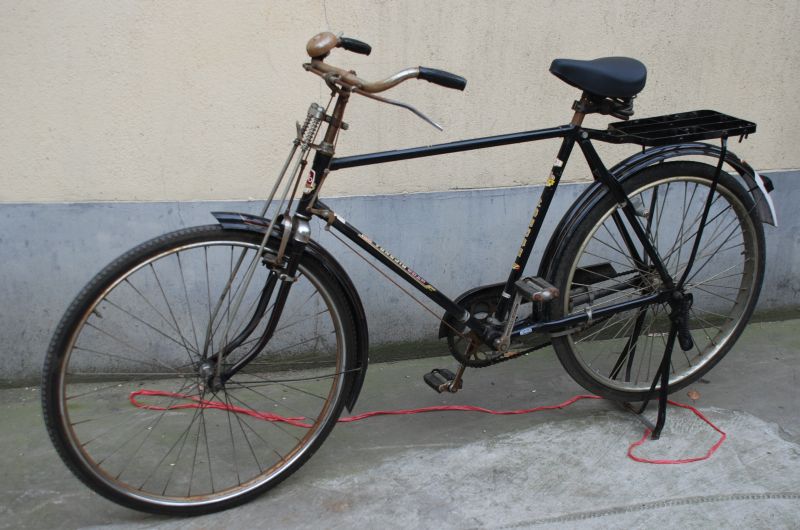
The perfect Sunday starts with waking up around 9 or 10 am and write or read a little on the balcony. The garden of the old house we live in is full of trees and green leafs have just come out, obscuring the view from all the neighbors. Birds sing in the trees, they create a countryside atmosphere right in the middle of the city. Drinking coffee on the balcony while writing or reading, I just enjoy the view. While Jiajia is waking up, I take my bike to the Paul bakery on Dong Ping Lu a few roads down. I often meet friends in this neighborhood, taking time to chat while buying croissants for breakfast. After eating French pastry and more of the balcony, I jump on my bike again for a trip to the old city.
The peak time of my perfect Sunday is biking along the streets of the former French Concession. I cruise on my bike under the shadow of plane trees. Passing by the old houses, it really feels like I am back in 1930’s Shanghai. I generally take Route de Seyes (Yong Jia Lu) up to Route Delastres (Tai Yuan Lu), then going on Fuxing Lu all along the way. Rue Lafayette (the old name of Fuxing Lu) is a one way street with a large bike lane. Crossing right through the whole of the French Concession, it has kept a lot of its old buildings and is still very charming. The end of Fuxing Lu reach into the old Chinese City… that now exists only in some people imagination since most buildings have been destroyed. Fan Bang Lu and Dong Tai Lu antique markets or Wen Miao Temple book market are my favorite places to go to.
Walking through the lines of shops, one needs a lot of attention to spot anything valuable amongst the stacks of stuff piled around. The most interesting sellers are the ones that get in bulk straight the demolition works. They are not the most appealing but something they have hidden gems. Most of the items are of little if any value… but you may find something interesting. This is when strong bargaining is required as the asking price is often beyond any reason. After shopping, I jump back on my back, going home via one of my favorite coffee place on Route Cassini (Taikang Lu) or Citizen Cafe (Jinxian Lu) and enjoying diner with a few friends. This is my perfect Sunday in Shanghai.
Climbing Zo Se (She Shan nowadays)
The Shanghai hills are the nearest thing to a mountain near the city. Driving there takes about 1 hour from the center if traffic is good. Located in the East of the city, it is quite near from the major expatriates area of HongQiao and HuQinPing. Since the opening of the Meridien hotel, it has become popular spot for Sunday family outing. While indulging with delicacies, few people seem to be aware of the hill’s history and climb to the top of it.
In the old Shanghai time, SheShan was known as Zose (Sheshan in Shanghainese). The name was also the one of the village at the bottom of the hill. The attraction on the hill was the Observatory established in 1900 by the Jesuits fathers. It was one of the most advanced observatory in Asia. Weather informations were gathered from all over Asia, to be able to predict the weather for sea transportation. Information was sent to Shanghai French Bund for display on the Guslav Tower. The observatory has now been turned into a museum but is still nice to visit.
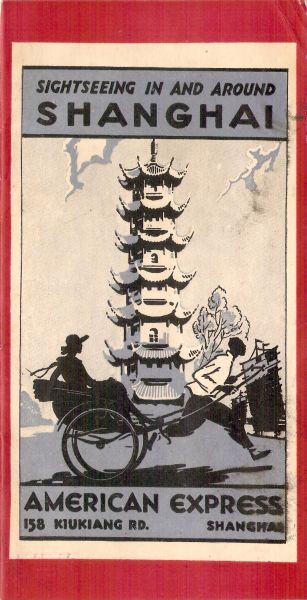
The location is mentioned as an interesting excursion from Shanghai in the American Express guide for “Sigthseeing in and around Shanghai” from 1934. The return trip to the hill took then 1 full day starting with train from “Shanghai North Station at 7.10 a.m” arriving at “Sungkiang 8:39am”. (Songjiang is now a part of Shanghai, with a metro line reaching is in less than 1/2 hour.) Traveller would then take a boat on the canals reaching Zose “in about 2 and half hour”. The guide also recommended to take your own picnic (in a picnic basket) to eat after climbing the hill before going back to Shanghai in a journey of about 4 hours by the same way. It even propose “a more leisurely alternative” in taking a boat on the Suzhou Creek from Shanghai to reach Zose in the evening and climb the hill the next morning. People climbed the hill enjoy the landscape of “surrounding plains, with their villages and cultivated fields and waterways winding like silver bands.” Rice paddies in that part of Shanghai are long gone, and villages have been replaced by compounds of luxurious villas but the viewing is still very nice from up there.
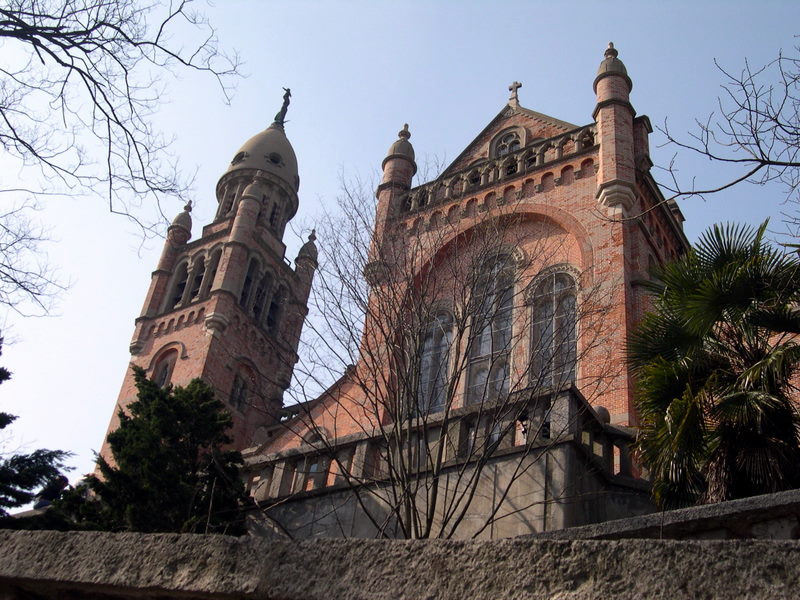
What is not mentioned on this guide from 1934… is the She Shan Basilica built by the Jesuits and finished in 1935. The cathedral is the largest in Asia, dominating the surrounding planes. It is very impressive and has been well renovated, after damages done during cultural revolution. Like XuJiaHui Saint-Ignacius Cathedral, it is a strong symbol of the Jesuits presence in this part of the world.
Shanghailander articles are published on an irregular basis. To be notified when a new article is posted, subscribe to the newsletter using this link, or follow the Shanghailander Facebook page.
Red Mandarin dress

This is the fifth novel of inspector Chen. I read the four others last year, after having seen author Qiu Xiaolong speaking at the Shanghai International Literary festival. The other novels were really enjoyable, so I could not wait to read this one. At first, it seemed just like another inspector Chen novel. Another young chinese girl killed in strange circumstances in Shanghai in the late nineties. Once again, the novel start with a crime that inspector Chen has to solve… this sounds very much like every inspector Chen novels. But this one deviates from the normal course really fast as the killer starts again one week later.

Putting the corpses in very visible location (first on Dong Hu lu / Huai Hai lu), on People Square the murderer is sure to create heavy publicity for himself… just at the time when our favorite inspector is putting his job on the back burner… I won’t spoil it all by telling the end, but this new novel is a page turner.
Qiu Xialong novels also evolve one after the other. They are all happening in the 90’s in Shanghai, but this one clearly includes a number of element that are more from 2000 Shanghai than 1990. From one novel to the next, we see the character’s life evolving and the city change. Part of the intrigue is still based on the Cultural Revolution period and dark secrets from this time come back to the surface many years later, but the whole topic also becomes broader including more part of Shanghai’s history. At the same time, the novel keeps in touch with the city’s reality and depicting the specific atmosphere of the transforming city. Reading it was a couple of hours of pure enjoyment.
Red Mandarin dress is a great Shanghai crime novel, but if you are looking for crime novels in Old Shanghai, Tom Brady’s “The master of rain” and Inspector Danilov’s “Death in Shanghai” are recommended. For French readers, Bruno Birolli’s “Le music-hall des espions” is also a great choice.
Reaching Heaven
Saint-Ignace cathedral was a famous landmark of the Old Shanghai. Built by the Jesuits in 1906 at the spot of any earlier one, its two towers were clearly visible from far away. The Catholic cathedral was located in the Jesuits estate in Shanghai, just outside the border of the French concession. The building suffered a lot during cultural revolution, with both towers severely damaged. It was rebuilt in the 1990’s and now looks more or less like the original. It is open again for religious services for Chinese catholic Church, for Chinese people only.

The Church may look like the original, but two things have changed. First of all the environment has been totally transformed along those years. The cathedral used to be visible miles away, it is now dwarfed by neighboring buildings and shopping centers. Furthermore, the original stained glasses have disappeared, replaced by plain glass. People are working on trying to put back stained glassed in the cathedral. I recently attended a charity concert to raise money to support this project. I was very much looking for it, as concerts in the church are something unheard of and I was not disappointed.

That night’s weather was perfect for it. It had rained the whole day giving a gloomy atmosphere to the city. I was running through the continuous rain, finally getting in after a bit of struggle with the security. The room was full with people, but it was the quietest concert crowd I have ever seen in China. Silence came and shortly after I got in, the Chinese philharmonic orchestra started to play Mozart’s requiem. In this extraordinary of the cathedral and the excellent music, one could quickly feel like we were in 1928, not 2008. It was really a touching moment to be able to experience this great music in such an historical place. That moment was really straight out of the movie “Empire of the Sun“.

The concert finally ended after dies irea, and the crowd of the Shanghai foreign and Chinese high society that was there could have also very well belonged to the 20’s or the 30’s. The succession of big cars and white gloves drivers at the exit perfectly completed the old Shanghai atmosphere. In the night, you could see the car lights only and the rain helped keeping noise from the nearby avenue down. I was walking under the rain in my trench coat, feeling once again in a time travel to old Shanghai enjoying this wonderful and unique evening.
Two months in rationnaires
Coming to Shanghai from Europe today is a 10 hours airplane trip. Time difference and the long sitting make it tiring, but it still is quite a short trip. I even know people who go to Europe from Shanghai for less than 24 hours or just a long weekend. Travel between Shanghai and Europe in the 20’s or the 30’s was a much longer journey. Passengers would embark on the cruise in Europe and travel on it for about two months before reaching their final destination in Shanghai. It is certainly difficult to imagine nowadays what it meant to be on the sea for such a long time. Passengers would disembark along the way for sightseeing, while goods would flow in and out of the ship. From writings from this period, it is clear that such a trip was in itself a fabulous adventure.
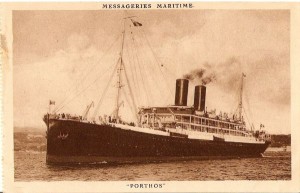
The main French shipping line was “Messageries Maritimes”. Based in Marseille, they were sailing on the “ligne d’Extreme-Orient”. The company was one of the three major companies of the French Concession (along with “Banque de l’Indochine” and “Compagnie de tramways et d’eclairage electrique de Shanghai”). Its headquarters was located on the French Bund, next to the Consulate (today between Yannan Lu and JinLing lu) in a building that is now occupied by the Shanghai Archives. The current building was erected in 1936, replacing a previous one built in the 1870’s. Following a 1926 brochure of the company, the ships stopped at the following ports of call: “Marseilles, Port Said, Suez, Djibouti, Colombo, Singapore, Saigon, Hong Kong, Shanghai, Kobe, Yokohama. Singapore omitted on return voyages.” One of the ship traveling along this line was the Porthos, pictured above.
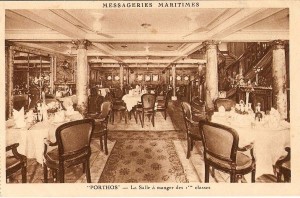
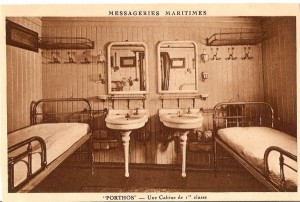
Recently I found a few more postcards of the inside of the Porthos and made some research about the ship (most information come from the website of Philippe Ramona). The Porthos had 112 passengers in first Class. It is clear from the pictures that this kind of travel was luxurious with great food served in a luxurious surrounding. Although the first class cabin was not as comfortable as a luxury hotel room it seems to have been still very convenient.
Second class travel don’t look so bad either with 96 passengers. The chairs of the dining room seem to attached to the ground, but this kind of travel was surely still comfortable. I don’t have pictures of the accomodation of the 90 3rd class passengers, but they were not the worst. Although its luxury was far from 1st class, it was still a world apart from the “rationnaire”, i.e “food ration” class. This was the lowest class which counted from 390 to 1000 passengers. I’m not sure how it looked like but people were clearly stacked on the top of each other for 2 months in the ship. 1st class travel was probably a great experience, but “rationnaire” travel was certainly much less fun and certainly not as glamorous as scenes from the movie Titanic. Long flight on today’s coach class are not always so comfortable, but at least they only last for 10 hours.
.sh
Saint Helena Island is mostly famous for having hosted Napoleon after he abidcated in 1815 following defeat at the Waterloo battle. First exile in Elba island near Italy proved not to be far enough since Napoleon actually came back and restored his power for a few months. This period is known in France as the 100 days (“Les cent jours”). For his second exile, Napoleon was sent as far as possible, i.e. Saint Helena Island, South Atlantic.
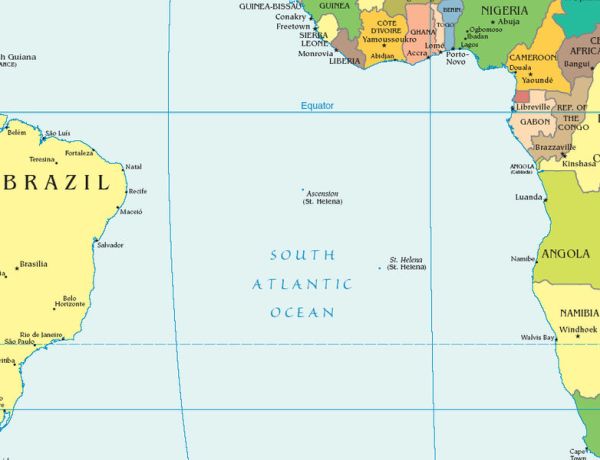
The Island seem to have all the features of the dream tropical island with blue sea and palm trees, though it is surrounded by rocky shores.About only 5000 people live on the island… but they found a new resource.

The internet domain name for Saint Helena is sh . It had little use until a clever Shanghai based weekly (8 days) started to use it for its website (the domain does not work anymore since the newspaper has closed down). They came up with www.8days.sh. I think that most people in Shanghai associated this URL with 8 days Shanghai. Suddenly, .sh started to find many more usage. There are not so many yet, but I have already spotted www.hudec.sh, celebrating the 50th year anniversary of Hungarian architect Laszlo Hudec death. As Shanghai is become a leading city in Asia and the world, I am pretty sure more of those will soon appear. The 2010 Shanghai World expo should also help a lot.
St Helenans have spotted the opportunity as a .sh domain currently costs USD 120 / year, about 10 times more than a .com or .cn . Like Tuvalu Islands making money out of the .tv internet domains, another tiny island finds itself with a great money maker. Shanghai is becoming richer and richer, and I am sure that this kind of money will not deter Shanghainese to proudly advertise their beloved city. With its (nearly) own domain on the worldwide web, Shanghai is really becoming a world city.
Sin City

I am not sure anymore where is the first time I heard about Ralph Shaw. It must have been about about 2006 when getting really interested in Old Shanghai. I heard the story of this ex-journalist from North China Daily News (the most important English Speaking newspaper in Shanghai and the whole of China) and tried to buy a copy of that book. Being not available in any English book store in China, I started to look on the internet. Sin City was displayed on several book sites but was listed as sold out. I finally got a second hand copy, not of the original publication of 1973, but a reprint in paperback from 1986.
I don’t think the book sold very well, certainly not helped by the cover of the paperback, sleazy and ugly, definitely not representative of the content. Since this book is in the bibliography of most books about Old Shanghai including the biography of Carl Crow I reviewed in a previous article, I was really interested about and really anxious to read it.
Sin City is the memoirs of Ralph Shaw, a Huddersfield (Yorkshire) boy who was sent to Shanghai as part of the UK military force. Incidentally, Huddersfield is the city where I spent nearly 3 years studying back in the UK. Shaw then became journalist then night editor of the North China Daily News, arriving in Shanghai in 1937 and leaving in 1949. Shaw was in his 20s in Shanghai and fully enjoyed all the pleasure that the city could offer in term of nightlife, drinking, partying and enjoying play with women. In Old Shanghai, like many men he found the perfect playground. His life during the period is depicted through a series of portraits, locations and actions. What is so interesting in this book is that he mentions all those people and all those places from the old Shanghai straight out of his memory.
Shaw arrived in Shanghai a few days before the invasion of the Chinese city by the Japanese forces and witnessed the mounting tensions between the British forces and the Japanese, until the invasion of the settlement in December 1941, his arrest the Japanese secret police and incarceration as a prisoner of war. There are many books about this period, but reading the actual experience of somebody who went through it is quite a unique experience.
Shaw does not stop at places and people, his memoirs also include a lot about the vices of the city, prostitution, gambling and corruption. He was definitely well informed and the light he casts on the city is less than flattering. Corruption, prostitution and alcoholism were normal practice for the most men in the foreign community in Shanghai and it reflects in the book. Once again, Shaw adds first hand details about places and people including portraits and funny anecdotes. The book is really good to take the reader in the Old Shanghai, into the smoky girly bars and opium dents. With cross referencing with other books, the picture of Old Shanghai really gets together while reading it.
What is more questionable and probably less interesting for most reader is the display of his own sexual performance. Although it adds colours to the story, it also takes it away from the plot and take off some of the book’s credibility. Some pages of Sin City would easily find there place in men-only literature. This is where most readers probably get lost. The erotic pages clearly dominated the cover and marketing of the book though they are not that many. It’s a pity such a narrow approach was taken for a book that is so full of first hand details about the old Shanghai.
Another great book written by an eye witness of Shanghai in the same period is John Pal’s Shanghai Saga. For more information about the Old Shanghai underworld, Paul French’s “City of devils” is a sure bet.
Looking for Hudec
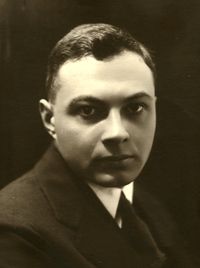 Lászlo / Ladislav Hudec was one of the main architect of the old Shanghai. He designed major buildings of the city, such as the Normandie Building on Avenue Joffre (toady Huai Hai Xi lu). He also introduced a new style to the city after his trip to America creating the most modern buildings at the time such as Park Hotel on the race course (see post Advertising Park Hotel for more details) and the “Green” House of Dr Woo on Avenue Road (today Beijing Xi Lu). His legacy can be clearly seen around the International Settlement of the old Shanghai. I got particularly interested in Hudec since he came from a city that is now Slovakia, but was Hungary when he lived there. This resonates with my own story as I spent several years in Hungary myself, before coming to Shanghai (see post in love again and Budapest Old and New” for more details).
One of my Australian architect friend was recently putting together a presentation about Hudec work. She knew very little about the history Central Europe. I had to tell the story of the Austro-hungarian empire and how the treaty of Trianon (1920) dismantled it, creating tensions that are still so vivid today. I even took my map of Hungary before and after Trianon treaty that I bought a few years ago in Budapest as a souvenir. Anybody who has spent sometime in Hungary will know exactly what I am talking about.
50 years after his death, Hudec is finding himself in the center nationalistic competitions that started after he left the, then, Austra-Hungarian empire. He never returned to it after the split into several countries including Hungary and Slovakia. Hudec was born in a city that was Hungary then, but is now located in Slovakia, know as Banska Bistrica today. He studied in Budapest Royal Academy of Science (see post Laszlo Hudec Alma Mater for more details), and wrote his notes in Hungarian, one of the most difficult language in the World. Hungary was ruling this part of the world at that time so his education was certainly in Hungarian, thus he is seen as Hungarian by Hungarians. At the same time, he is referred on some of his buildings in Shanghai as Laudislav Hudec, a architect from Czechoslovakia. While making Slovaks pleased, this surely infuriates any Hungarian knowing about it. In any case, his genius knows no border.
Having heard the story from both sides so many time, when I lived in Central Europe, I find it really strange to be caught back this typical Central European story such a long way from its origins, now that I live in Shanghai. Both countries are now part of the EU and entered the Schenghen space but this competition is still going on. Seen from China, they are tiny nations (Hungary and Slovakia’s population combined is smaller that Shanghai). Hudec was taken prisoner on the Russian front in 1917 and escaped a train to a prisoner camp in Siberia to finally arrive in Shanghai. Not able to return to Hungary after 1945, he moved to the USA when Old Shanghai closed its doors to foreigners. Though is never went back, he still finds himself caught back by the Hungary/Slovakia competition even after his death.
This will not stop the celebration of the “Year of Hudec” that is taking place all over this year, celebrating his work that is so much part of Shanghai (more details on www.hudec.sh).
* Update from 2017: Nearly 10 years after the original post, it is now clear that László Hudec is seen as a Hungarian architect in Shanghai. Thanks to “The year of Hudec” in 2008, as well as numerous books and article, László Hudec is now fully recognized in Shanghai. At the same time, he is also gaining fame in Hungary, that he left in his youth, never to come back.
For everything else there is Mastercard

My last trip to London was like an advertisment for a financial services or credit card company.A long flight in a comfortable seat, followed by a trip to an old friend’s house. After a few glasses of wine we started counting the number of years since we met the first time. We were actually living together in a Huddersfield’s University dorm in… 1993, i.e. 15 years ago. We don’t meet very often (last time was 4 years ago), but catching up was really nice. My friend is now married with Lucy and has little baby Grace. Life has changed a lot for both of us, but we still connected instantly. After so many years, the bond is still there.
The next day included a little bit of shopping, some sightseeing finishing with beers and then diner with 2 old friends from Budapest. Once again, we probably did not meet the 3 of us since 4 years, but it felt like we left each other yesterday. Suddenly this India restaurant near Gloucester Road transported itself to good old Budapest. The feeling of finding back all those friends was really nice and definitely priceless. Like in the add, for everything else there was Mastercard but rejoining these old friends was a pleasure that no money could buy.
London recalling
Shanghailanders like me are used to the mix of architecture that makes up Old Shanghai. Elements of various nations were taken to create buildings in the city and seeing faux-Tudor style next to Art Deco are quite common. All of them are reminders of the past and often much better than the present rows of unimaginative apartment buildings or ugly office towers.
It’s only when coming to European capitals that one suddenly realizes how Shanghai old buildings are most often imitating the style of the home or adoptive country of the one who built them. I remember taking a suburban train to Paris, and looking at houses from the 1910’s, 1920’s that look very much like the ones in my neighborhood in Shanghai’s French concession (see post “portrait of an old neighbour“). Similarly, Mexican or Spanish revival buildings are very similar to the ones found in California (see post “”Spanish revival architecture in Shanghai” and “California Dreaming“), and German house on Xin Hua Lu are very much in the style.
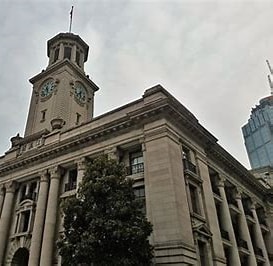
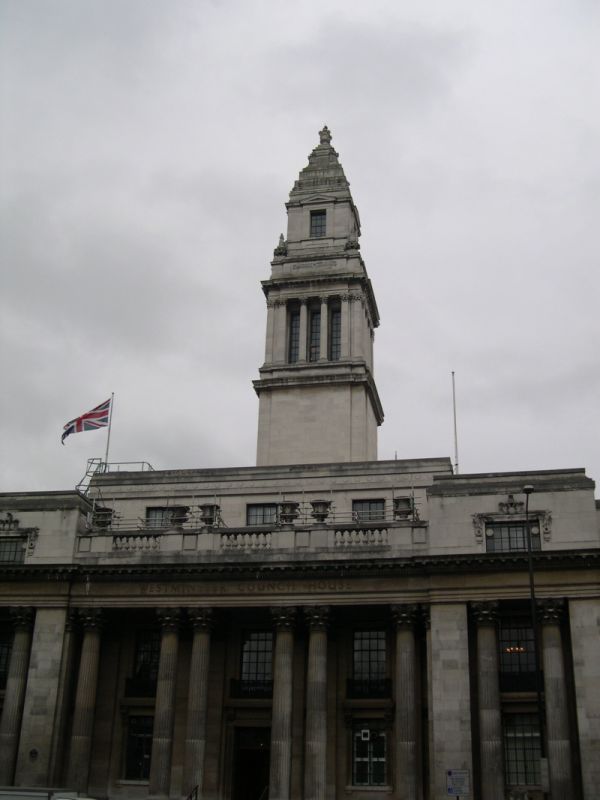
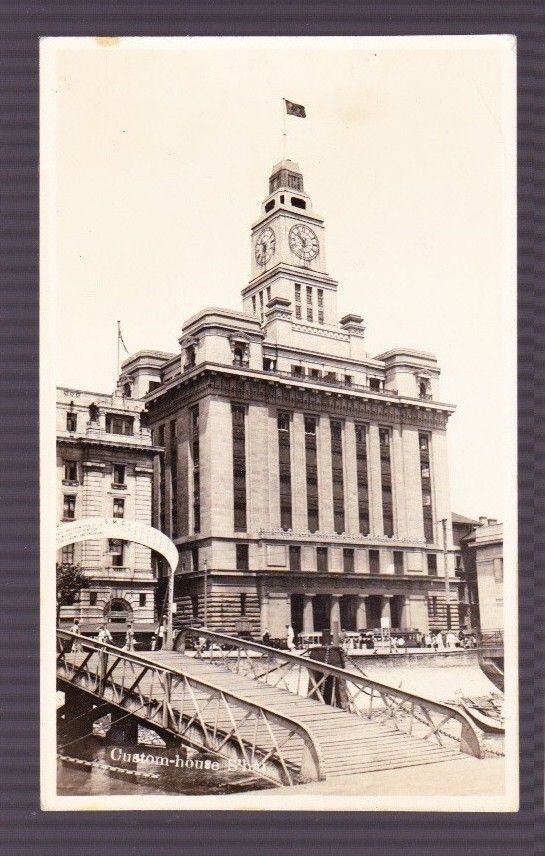
I had a similar déjà vu feeling walking on Marelyborne road in London a few days ago when I ran into the Court of Westminster (center picture) and could not miss the similarities with some of the Bund’s facades, in particular the customs building. The little tower on large buildings that I so much associate with Shanghai is just typical from British architecture from this period. The building even have the same flag poll with a Union Jack floating on it. It does not take much to imagine a Union Jack floating on every tower on the Bund like it floats on the one in the picture.
Walking around the area, I went to neighboring Regent’s Park. Regent College building does also look like some of the large mansions in old Shanghai. Similarly, some of the Lilong or Shi Ku Men houses have a lot in common with terraced houses in London or with row of houses in The Netherlands. They were also designed to maximise use of limited space and they tend to have a similar design of narrow front with deep rooms piled on the top of each other inside the building.
Old Shanghailanders only reproduced the architecture they were used to in their new home. Just like large columns and small towers represented power in t19th century London, it represented power in 19th century Shanghai on the Bund. With gray sky and brick or gray stone buildings, parts of London from this period feel like parts of Shanghai to me. People of the Empire really managed to re-create the illusion of their home countries far away from home… or Shanghai has become so much a part of myself that I see it everywhere I go.