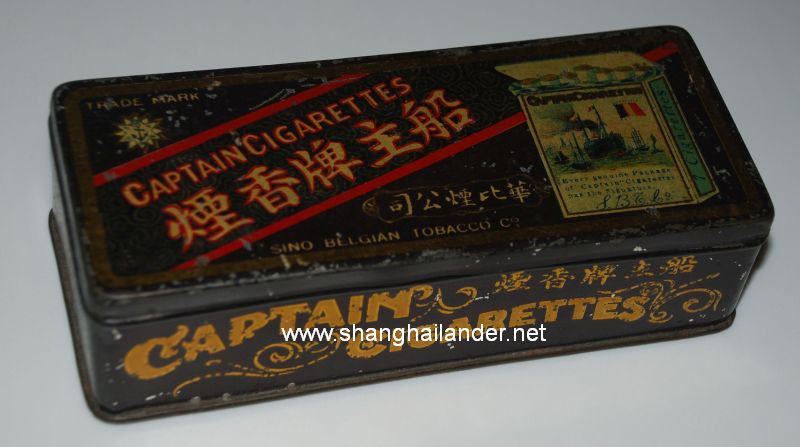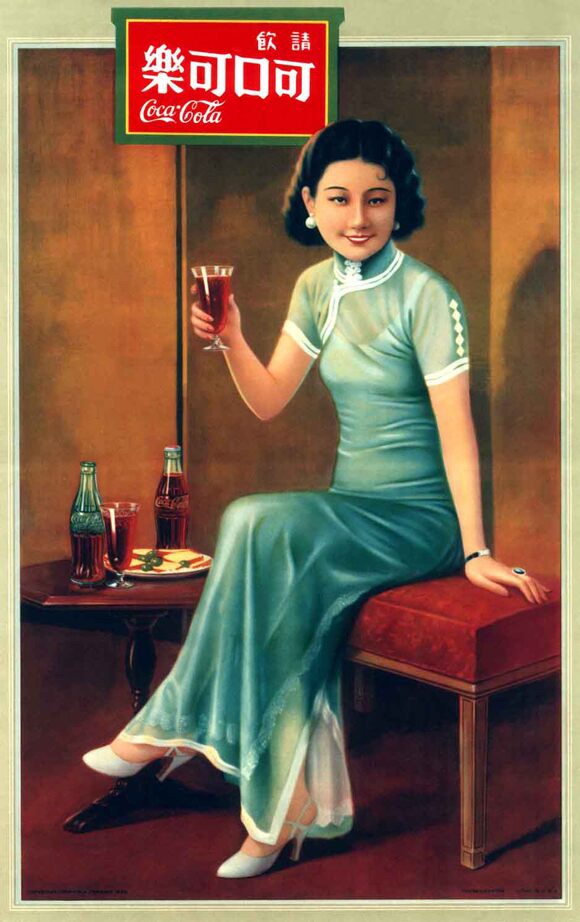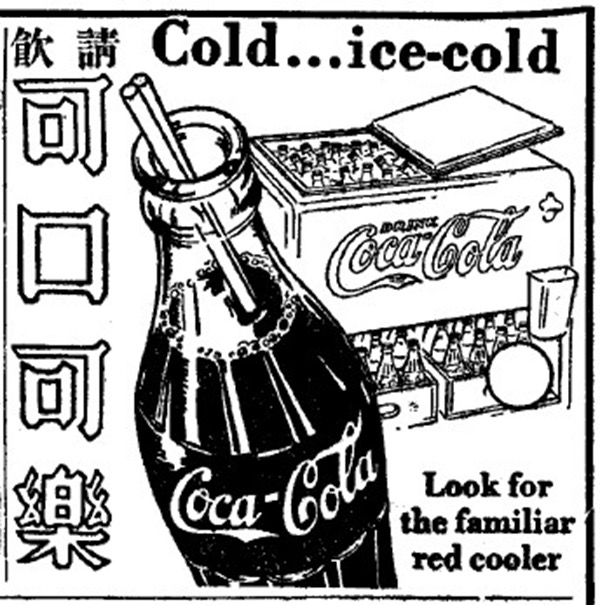
Advertising posters were the main way of promoting brands in the 1920’s and 1930’s Shanghai. The methods was brought from the USA mostly by Carl Crow, who made the largest advertising company at the time.
Although there are many fakes and reprints, real old posters are really rare to find nowadays. I happened to buy this one from an antic dealer in 2007 (I think). After years of storage, it is now properly framed and I take a good picture of it.
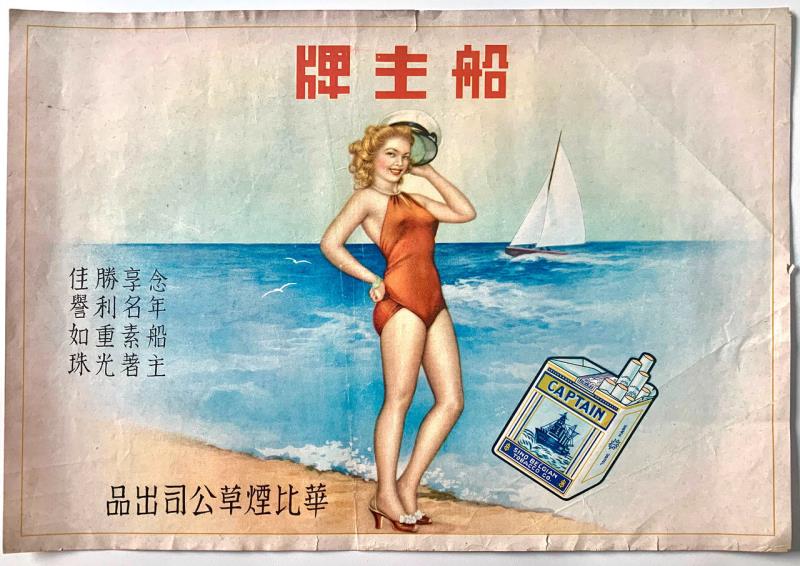
As common at the time, the center of the picture is a young Chinese girl, dressed with foreign clothes and in a foreign-style environment. This kind of advertisement was showing best style and modernity to be associated with the cigarette brands, so the author used the most up-to-date style. for closing and environment.From the layout as well as clothing, I would date it from the early to mid 1920’s, rather than the 1930’s seen with many of those calendars.
Just like today, advertising from that period was following the latest style. In the mid 30’s, they would show of the environment, focusing more closely on the woman. Her dress and posture would be more modern, and suggestive. Lettering would be more Art Deco inspired.
Russia-China Tobacco Company (驻奉中俄烟草公司 in Chinese) was located in Fengtian (today Shenyang) but little more is known about the company itself. It produced quite a number of advertising posters, that can be found on various auction websites. They range from mid-20’s style to early 30’s. Although some seem to be from a very similar period, I did not find pictures of this particular one.
On the way to visit Qibao Old town, in Minhang district, I was not expecting to see any Art Deco architecture. This part of Shanghai used to be a separate village in the countryside, reachable by boat, crossing the swamps over the small rivers that were surrounding Shanghai then. The trip would have been shorter, but similar to the one to Sheshan (see post Climbing Zo Se for more details).
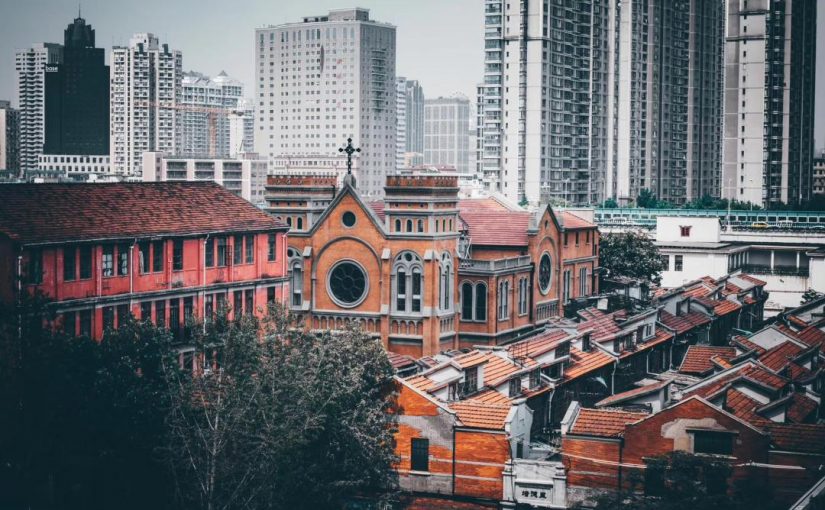
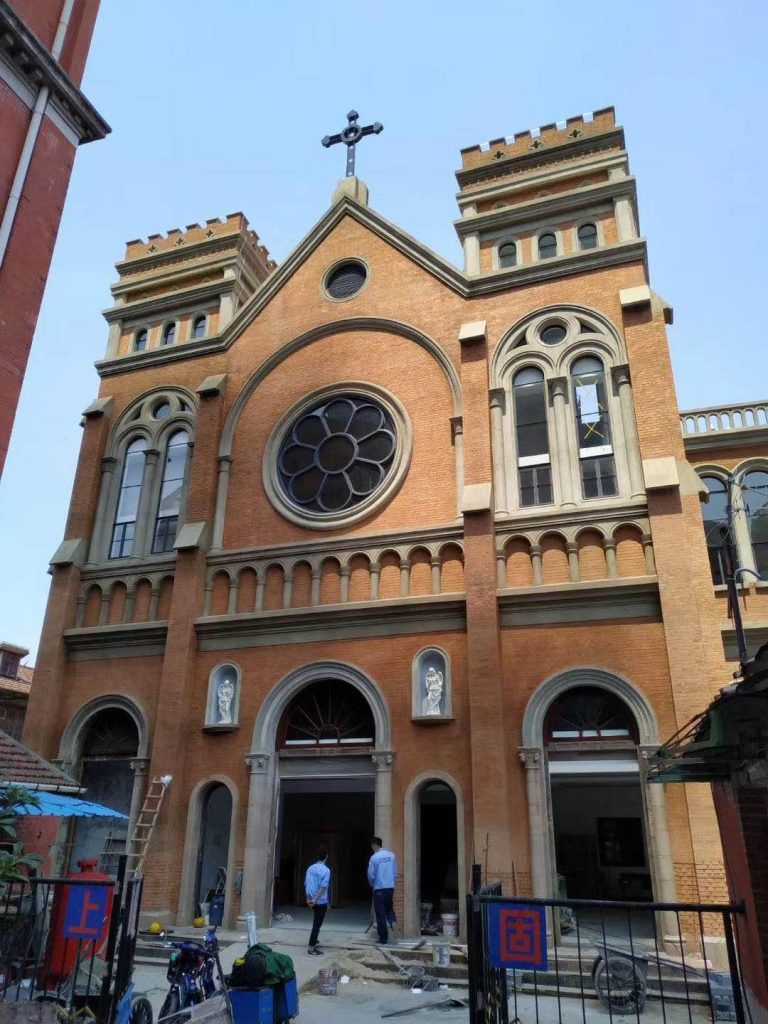
Although Old Shanghai was one of the largest cities in the World in the 30’s with more than 3 million inhabitants, its footprint was much smaller than today’s Shanghai. If early 20’s century architecture, in particular Art Deco, can be found in the center of Shanghai, it is unheard of outside of today’s first ring road. The only exception being Hudec Laszlo’s Catholic Country Church, built then in the countryside, now located in the residential area of Hong Qiao (picture above) in Changning district.
I was then really surprised to discover this Art Deco building close to Qibao Temple. It was hidden between a large advertising poster and seems to be soon to be demolished, but the style was impossible to miss. How could an Art Deco building end up here?
The mystery did not last for long, as although the style was very much modernist / Art Deco, the cover of small tiles is typical of the 1980’s architectural style in China. This building is the former Minhang phone exchange. This kind of building seems to have crossed through time more or less unchanged, just like the ones in the former French Concession or the Former International Settlement. It was probably the first modern building in the area, and like in other cases, architects in the 80’s reused techniques and styles from the late 30’s or 40’s. Architecture did not change much in the meantime in China, so the modern ideas of Old Shanghai were still modern 40 years later. As new technology allowed larger buildings, this lead to Frankenstein Art Deco (see post Frankenstein Art Deco for more details).
Even if it was out of fashion for more than 40 years went it was built, it must have been the top of modernity in this rural surroundings… and somehow it still is very modern. Too bad it will soon go down.
I only became interested in Art Deco in Shanghai, long after leaving Budapest where I lived for a number of years (see post “Budapest Old and New“) . Just like in France, Art Deco was until recently seen as a minor style, often enclosed in the “Entre- deux guerres” period (Literally “between the 2 wars”), see post “Art Deco in France” for more on that. During my previous trip to Budapest, I was looking for Hudec connection in Budapest (see post “Hudec Alma Mater“. This time I walked around the city in search of Art Deco.
The search was greatly helped by a great guide book, from Zoltan Bolla, that is both in English and Hungarian. I had already looked for Art Deco in Budapest districts where I used to live in (mostly 6th, 7th), including UjSzinhaz theater, that is on the guidebook cover. This time I went to the 8th, 11th and 13th districts, parts of the city I never really visited while living there, but main points of Art Deco and modernist style. The border between Art Nouveau, Art Deco and modernism are often blurry and Budapest is no exception. This made a really interesting trip.
Art Deco on Népszínház utca
8th district
This area is pretty central, and Art Deco buildings are spread between earlier styles building. I focused on Népszínház utca, from Blaha Lujza Tér. The largest and most noticeable building on that road (though not the only onw) is pictured above, a beautiful and massive corner building. Although it is very central, the area was not very desirable when I lived in the city. This has massively changed and it is transforming fast.
11th district
Spending most of my life in Pest, I rarely went to Buda, the other side of the river. This is the home of one the main Art Deco et modernist area, around Móricz Zsigmond Körtér, with its large modernist buildings (picture above). I always felt that this part of the city was mostly about large boulevards, but strolling the small side streets looking for Art Deco completely changed my impressions on the area.
Small leafy streets with Art Deco buildings, like Szábolcska Mihály utca (number 3 on that street is pictured above) are really quite, with a high concentration of Art Deco and modernist buildings, as this part of the city was really developed in the late 20’s and 30’s. Away from the traffic, but close to transportation, they make a really nice area to live, away from the tourist crowds.
Further down Bartók Béla út, around Kosztelányi Dezsö Ter, Art Deco and modernist buildings are much larger, overlooking large boulevard. This gives a much more urban and modernist feeling.
13th district
Although I lived in that area at some point, I only realized many years later that my flat was located in a modernist building from the 1930’s. This part of the city has quite a mix of buildings, including art Nouveau, Art Deco and mordernist. The most noticeable Art Deco part is surely around Szent István Park (above picture). This is also the location of Duna Park Kaveház, a fully renovated Art Deco Cafe and restaurant. A great spot for a rest while on the hunt of Art Deco in Budapest.
Dunapark Café
Another really valuable guide about Art Deco and modernism in Budapest is the new guide book from Kovács Daniel, with pictures from Gulyás Attila. Although, it is only (so far) in Hungarian, the English translation will be a great addition for international Art Deco lovers.
Thanks to a recent business trip, I finally had the chance to view the ” Art Deco, the French-China Connection” exhibition in Hong Kong. Opened in early March, it will last until end of June and is worth seeing for Old Shanghai fans visiting Hong Kong.
The exhibition is the result of a very unique cooperation. It’s origin is the major Art Deco exhibition in Paris that took place in 2014 (see post “1925, when art deco dazzled the World” for more details), with a number of major pieces having been brought from Paris. Had this new exhibition been only a short version of the Paris one, it would already have been really interesting, but there much more to see.
famous “meuble a fards” from Ruhlmann, brought from Paris
One of the major and little known Art Deco link between France and China, is the mausoleum statue of Sun Yat Sen in Nanjing. If the purple mountain based mausoleum and the statue are extremely famous in China, few people know that the statue was created by French sculpture Paul Landowski in Boulogne near Paris, before being shipped to China. Landowski was also the creator of another World famous piece, the Christ statue overlooking Rio de Janeiro. (See post: From Boulogne to Nanjing for more details).
French sculptor Paul Landowski, with his Sun Yat Sen statue.
With a France-China Connection theme, Shanghai art deco was also called in, with the help of major Shanghai based collector including Deke Ehr, Patrick Cranley and Tina Kanagaratnam. The original Paris Art Deco exhibition had shown a few photos of Shanghai Art Deco architecture by Leonard & Vesseyre company. Here, the Shanghai part is much larger with great examples of Shanghai Art Deco furniture, as well as fashion and famous art deco advertising posters. Side by side with the ones from Paris, they highlight the similarities between style and fashion in both cities during the same period.
Shanghai Art Deco furniture, with the backdrop of the Shanghai Bund
Many more of those advertising posters from Hong Kong were on display, but the most important contribution to the exhibition is the whole room full of 1920’s and 30’s compact boxes or “necessaires” as they are called in French. These small boxes for ladies to carry make-up became really trendy in this period, and the collection on display is simply amazing thanks to the Liang Yi Museum.
A few of the Art Deco “necessaires” on display
Although the neighborhood of Kowloon Tong is quite far from the center of Hong Kong, the exhibition is definitely worth the trip for anybody interesting in Art Deco and Shanghai.
It is open until 30th June (10:00 to 19:00, closed on Monday), at CityU Exhibition Gallery, 18/F, Lau Ming Wai Academic Building, City University of Hong Kong, 83 Tat Chee Avenue, Kowloon Tong
British author Paul French has lived in Shanghai for many years, and is vastly knowledgeable about Old Shanghai. Known for his in-depth research, he is also the author of The Old Shanghai A-Z , a reference book for anyone researching Shanghai history. French turning to crime solving inquiry in previous book Midnight in Peking, turned to be really interesting. Being passionate of both crime novels and Old Shanghai, I could only be interested in his new book, City of Devils, a Shanghai Noir.
Just like Midnight in Peking, City of Devils is not a novel. French takes a character that attracts his interest and research it in all directions possible. City of Devils is the story two characters of the Shanghai underworld. Jack Riley was the king of the slot machines in Shanghai, while Joe Farren was running entertainment shows at the top places like the Canidrome ballroom and the Paramount. Their course in Shanghai crime met numerous times, while they became allied, fell out and got in business again. The stories of both characters is really fascinating, showing the opportunities and the lawlessness of Shanghai in that period.
Little was known about the two central characters before French started his research. Information from a great many different sources have been put together, starting the local press of the time, North-China Daily News, JB Powell’s China Weekly Review and (never heard of before) blackmailing newspaper Shopping News. Although the book does not include a bibliography, they are references to many books about the period or written by people who lived through it, including Ralph Shaw’s Sin City, Bernard Wasserstein’s secret war in Shanghai, Frederic’s Wakeman The Shanghai Badlands and many more. He also search the official records from the Shanghai Municipal police, and other Shanghai institutions as well as archives from foreign countries consulates that are stored in their home country. A number of well known Shanghai researchers have also contributed sometimes unpublished information that have been incorporated the book, including Prof Robert Bickers, Russian researcher Katya Knyazeva and many more authors on the topic. The amount of information and the number of sources is quite extraordinary. Researching this books must have been like a real police inquiry, with attention to all possible details.
Beside those larger than life characters, the most interesting part is the description of Shanghai foreign underworld including numerous people or location that are mentioned in books of the period but on which little was known. This creates a great picture of the darker side of Shanghai that mixes well with French detailed knowledge. From the known facts he create an entertaining story, by bridging the missing parts with very plausible and well informed details. City of Devils is an entertaining read about a side of Shanghai that is lesser known. It is also a very deep research that is presented in a very entertaining way.
With its mix of influence, Old Shanghai had bits of pieces coming from all over the World including Beaux Arts style, Art Deco, Andalusian, Mexican revival, New Normand, German, traditional Japanese to name a few. They all added up and sometimes got inspired by traditional local style or its modern incarnation, neo confusion (sometimes called Republican style). While walking around in Old Shanghai, it’s sometimes surprising to see details that are heavily influenced by another place.
Pattern on Jian Guo Lu
I have been fascinated by the floor tiling pattern in the picture up, since I discovered it a few years ago. The original picture was taken on the ground floor of the FONCIM D building (1933) at the corner of Jian Guo lu and Gao An lu. The building was designed by the firm Leonard, Vesseyre & Kruze (or LVK) (See post ” Shanghai Art Deco master” for more details or my article, in French, in Lepetitjournal.com Shanghai edition). The firm was highly creative and the building was designed for their largest client, the FONCIM real estate investment firm, so I first assumed it was unique.
FONCIM D, by LVK (thanks Shanghai kat for the picture)
The only other similar pattern I found was in a villa on Yong Jia Lu, a few hundred meters from the FONCIM building. The area was built by the LVK firm (Leonard and Vesseyre’s personal homes are nearly opposite from this building), including this one, probably from the mid 30’s. The tiling shape is slightly different, with the beige stripe wider, but still very similar. This was the only place were I saw this pattern until a recent trip. A later found a similar pattern with different colors in a building on Hunan Lu (see post more on tile patterns).
Similar floor patter (picture ShanghaiKat)
Having diner in Paris a few days ago, I realized that the early 1900’s building had been extended by an Art Deco part with the tiling on the picture right. It took a while to retrieve the Shanghai picture, but when confronting both, the similarity was striking. So the Shanghai Art Deco pattern was probably not the invention of LVK, but probably imported from France. Looking for more about this pattern, I received a big help from my friends of the France Art Deco Facebook group (https://www.facebook.com/groups/franceartdeco).
The same pattern in Paris
A similar pattern was used for the flooring of the kitchen of flagship cruiser SS Normandie. Launched in 1935, SS Normandie was the largest cruise ship of its time, a floating palace fully designed in Art Deco Style. Because of WW2, it only operated a few years before sinking in New York in 1942, but it is still a legend in term of cruise ships, technological achievement and as an Art Deco masterpiece. Exemple of the ship’s decoration was shown in the Paris Art Deco exhibition in 2014 (see post “1925, when art deco dazzled the World” for more details).
Same pattern in the kitchen of the Normandie cruise ship
Chef en cuisine on the Normandie
Unfortunately, all pictures of the Normandie are black and white, so it’s impossible to know the original color of the kitchen tiling, but in any case it looked quite similar to the one used by LVK on Jian Guo Lu. As the pattern originated from France and it is so rare in Shanghai, it is likely that the actual tilling was imported from France. Old Shanghai was a modern city, in touch with the latest fashion in the World… just like it is today.
More location with the same pattern in Shanghai can be found in post “More on tile patterns“.
Many autobiographies have now been published by people who live in Old Shanghai, and most of them were written by westerns. The really interesting part of Remembering Shanghai, is that it is a story of a Chinese family in Old Shanghai. Living in the same city as the foreigners, but often not in the space, the personal story makes a really interesting read.
The first wave of autobiographies about Old Shanghai was published in the late 1940s and 50s, when foreigners who used to live in Shanghai, realised that they would not go back after the communist takeover. Among those are “My twenty-five years in China”, by China Weekly Review publisher John B. Powell, as well as Emily (Mickey) Hahn books published after her departure, including “China to me” (for more details about Mickey Hahn’s life in Shanghai, see article “Tara Grescoe’s Shanghai Grand“). Since the events in China were still very much in the Western news, those books sold well at publication.
Another wave of Old Shanghai books came when those people who had lived and worked in Old Shanghai retired and spent time remembering the golden days of their youth, mostly in the 70s. At that time, Old Shanghai was pretty much a forgotten topic, those books sold in small numbers and are now difficult to get. Two good examples included Ralph Shaw’s Sin City (Ralph Shaw was in the Shanghai Police force) and John Pal’s Shanghai Saga (John Pal was a employed in the customs office). Although facts are sometimes distorted by memories, those books are great source of first hand details on life in Old Shanghai.
With the rise of the city on the international scene, Old Shanghai books have been in fashion again from the early 00s. Some who left Shanghai in the late 1940s started to come back to the city they had fondly kept in their memories. Some of the most well known are Liliane Willens’s Stateless in Shanghai as well as Rena Krasno’s book (stranger always, Once upon a time in Shanghai). Both lived in the former French Concession of them attended the French Collegue Municipal Français. Another one is Tea on the Great Wall, by Patricia Lu Chapman. Author give a first hand view of foreign Shanghai, but what makes the new Remembering Shanghai special is that it was written by Chinese people.
Author Isabel Sun Chao was born in a wealthy family from Changshu, in Jiangsu province. Her father had relocated to Shanghai in his youth and was managing the family properties in the city. The life of Isabel and her siblings was on the outside very similar to the one of wealthy foreigners, as the children attended the best schools in the international settlement. Inside home, it was quite different, as a permanent fight between traditional China and modern Shanghai was raging within the family. Traditional China was represented by her father, a poet and a Chinese painting collector, and even more by Qingpo, the grand mother ruling the house with an iron fist. On the contrary, Isabel’s mother was embracing the modern city and its life of fast pace. She eventually became one of the first Chinese women to actually divorce her husband.
Just like foreigners stucked in Shanghai after the Japanese , Isabel and her sister Virginia went through the privation of the war, and finally were able to be the only two members of their family to escape Shanghai before the rise of Communist power. Due to political events, the two branches of the family were separated for years and communication was lost for many years. It’s only in 2008 that Isabel went back to the view the family house on now Zhenning Lu, together with her daughter Claire.
I actually met with Isabel and Raymond Chao in 2011 and wrote a post about it (See post “Shanghai exiles” for more details). This showed them that their story interested people and helped turning the project into reality, with publication in end 2017.
The horse race track of Shanghai (today’s People square) was at the center of the entertainment district in Old Shanghai. Hotels were built in the neighborhood including the home of Chinese stars, Yangtze Hotel (see post Yangtze Hotel for more details), the Great China Hotel and the New World Hotel.
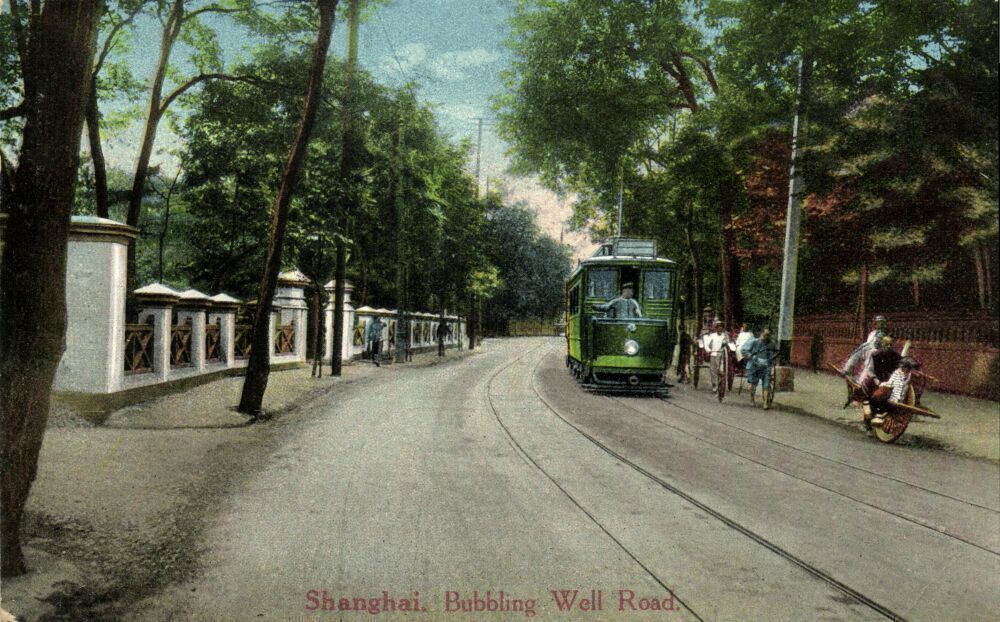
Lászlo Hudec Park Hotel opened in 1934 on the Northern of the race track, on Bubbling Well Road. Financed by the Joint Savings Society, a major Chinese financial institution, it was a clear attempt to compete with the Cathay Hotel that opened a few year earlier on the Bund. As displayed in the advertising material below, entertainment was the main point of the hotel’s offer. If the Cathay was the home away from home for foreign travelers, the Park Hotel was designed with residents in mind, as well as guests coming to enjoy the race track and other local entertainment establishments. Those included the neighboring theaters (Grand Theater, Nanjing Theater and Metropole Theater), as well as the shopping temples on Nanjing Lu (Wing On, Sincere and Sun Department stores) as mentioned on the below map.
Advertising leaflet for Park Hotel in Shanghai
I particularly like the hotel silhouette and the characters displayed. Their dress look very much like characters from movie Casablanca. Another specific feature is the display of parts of the Chinese city (Longhua Pagoda and the Civic Center, in today Yangpu district ) as possible tours destination from the hotel. Although Longhua Pagoda was (and still is) a major tourist destination, the new Shanghai area of Jiangwan was rarely mentioned in foreign guides.
Using the same concrete raft technique as the Cathay, the 24 floors building was the highest of Shanghai… and in Asia. It only lost the Shanghai crown in the 1980’s when high buildings construction restarted. For decades the Park Hotel tower dominated Shanghai sky. The view from the top floor was unobstructed and stunning, as seen on the picture below. From up there, one could practically see the whole of Shanghai. For people of the time, this view must have been as stunning as the one from today’s Pudong skyscrapers.
Since most of the original Art Deco interior and furniture has disappeared, the Park Hotel does not compare to today’s luxury hotel anymore. The exterior is now roughly back to its original design, but inside only the ball room of which the circle floor was designed by German Bauhaus trained architect Richard Paulick has survived. When Park Hotel opened though, it was one of the best of Shanghai, competing not only in height but also in the best services with the Cathay. Below is a rare advertising leaflet for the
Rare advertising for Park Hotel
Pictures of the original Park hotel and decoration are extremely rare, but the hotel was clearly of the highest standard. It hosted two major restaurants, the Main Dining Room “remindful of the choicest wines and Epicurean French Cuisine” on the second floor and the Grill room on the 14th floor “which has a reputation on its own”. 14th floor was also the location of the Sky Terrace, I am preparing a special post on this one.
The Grill Room of Park Hotel. Thanks to my friend Peter Hibbard to find this one
It also had a lounge on the 3rd or 4th floor, ideal location for drinking cocktails while watching the horse races. The highest attention was put for the kitchen… though no Chinese restaurant is mentioned. “The pastry cook has his place, and quite an important one” as high teas were (just like today) an important market for the hotel. The Park Hotel’s pastry reputation survived the years, as it was one of the few places to buy cakes until the bakery revival a few years ago. It was particularly famous for its Palmiers, or “butterfly cookies, Hu Die SU” as it is called in Chinese, that are still on sale today (Please see post “Tasting Old Shanghai” for more details).
It was quite a shock when I discovered this leaflet in a market in Shanghai more than 12 years ago. It can date it from 1937 or 1938, as I know from other sources that Mr T M Lamb was the GM in 1938. Nearly eighty years later, this advertising for Park Hotel looks very much like today’s top hotels promotion material. Another form of advertising for Park Hotel was hotel luggage labels, see post “Old Shanghai luggage labels” for more details.
In previous post “China General Omnibus Company“, I got interested in Old Shanghai bus networks in the former International Settlement. After some more research, I found the complete list of the bus network in all three parts of the city.
This is an extract from a 1931 short guide to transport in Shanghai. The tourists guides did not really address buses network, as I guess tourists of the time were travelling in luxury. This particular guide was dedicated to service men, published by the Navy YMCA. Route N1 was following a communication line of Shanghai then, and of Shanghai today: Bubbling Well (Jing An Temple today) to Hongkew Park (today Hong Kou Gong Yuan). It went down Nanking Road (today Nanjing Road), the Bund, North Soochow (today Bei Suzhou Lu) and North Szechuen Road (Today Sichuan Bei lu), to reach Hong Kou Park.
Bus Routes and Express Routes
Others roads included a few surprises. First of all, there was a bus line driving up Hong Qiao road, ending close to Hong Qiao airport. This route 4, from Siccawei (today Xu Jia Hui, English spelling, French spelling was Zikawei) to Monument road (today Suining lu, next to Hong Qiao airport). Although Hong Qiao Road was already lined with villas in the 1930s (including Eve the one of Sir Victor Sassoon, see post “Shanghai Grand” for more details), it is still surprising to see public transportation go that far West.
The other interesting part is that there was Express Route for buses, on the top of the normal routes. The four of them were ending at the Bund, starting from Jessfield Park (today ZhongShan Park) or Brenan Piece (in the North of the international settlement). They took the main West-East roads of Shanghai, being today’s Nanjing Road (Bubbling Well Road followed by Nanking Road), and today’s Yannan Road (Avenue Foch, followed by Avenue Edouard VII). Express Route A was competing with a tramway track (see post “Old Shanghai Tramways” for more details) and is very much following today’s metro #2.
Bus N21 was going from the very East to the very West of the French Concession, from the French Bund to Zikawei (today Xu Jia Hui, French spelling). It had the same start and finish than the main tramway line of the French Concession (see post “Old Shanghai Tramways” for more details).
Bus N22 was loop route from the French Bund and back to it. I went through the small street of the French Concession including Route des Soeurs (today Ruijin Lu, see post “Brooklyn Court, Route des soeurs“), Route Lafayette (today Fuxing Lu), Route Frelupt (today Jiang Guo Xi Lu), Route Dufour (today Wulumuqi Nan Lu, see post “Shanghailander Cafe and Bakery“). This is probably the stop where the original inhabitant of my former home, or rather their staff, would take the bus (see post “Leaving route Kauffmann” for more details). The bus would then go back on Avenue Pétain (today Hengshan Lu), Route Pottier (today Baoqing Lu, where my first home was located, see post “first home in Old Shanghai” for details) and then back to Route Lafayette all the way to the Bund.
Most residence at the furthest point of this loop were built in the late 1920s or 1930s creating need to transport people from and to an area that was previously not really developed, so the line must have been pretty recent in 1931. Cars and buses were driving left-hand side (this changed only in January 1946), so a number of road the bus took are now one-way streets, in the wrong direction. Similarly, Route Lafayette was driven in both ways, when it is now mostly a one-way-street. Traffic direction and driving side may have changed, but the main lines of communication in today’s Shanghai are still similar to the ones in Old Shanghai.
Riding newly opened trolley 71 from the west of Shanghai to the Bund is very practical, and always makes me think about Old Shanghai. Tramways were installed in Shanghai first in the International Settlement in 1908, then in the French Concession and the Chinese city (see post Old Shanghai tramways for more details). If tramways were the most modern urban transport in the 1900s and 1910s, by the 1920s and even more the 1930s, they were taken over in modernity by buses.
First Shanghai buses in 1924
The China General Omnibus company was incorporated in Hong Kong in 1923, like many companies in Shanghai at that time, to operate bus services in Shanghai. Part of the Sasoon group, it ran bus routes in the International Settlement and beyond. The first routes were opened in 1924, to increase to about 20 lines in the 1930s. Those routes mostly followed main roads and are quite similar to today’s bus line. Buses in the French Concession were separately operated by the “compagnie française de tramways & d’éclairage électrique de Shanghai” which was also operating the tramways.
China General Omnibus Company stock
Picture left is a list of some of the bus routes (the second page is missing), with some being very familiar, starting with Route 1 from Jessfield Park (today Zhong Shan Park) to the Bund. This is actually pretty close to parts of today metro line 2, and was also following Tram route N2 (see post Old Shanghai Tramways for more details). Route 9 had the same beginning and end, but was going Avenue Foch and Avenue Edouard VII (both streets are now Yannan Lu). This is quite similar the eastern part of today’s 71 bus line. As the road was the border between the International Settlement and the French Concession, there was no tramway line.
Above map is a full route map of the China General Omnibus Company. The network was very extensive, allowing to travel all over the international settlement and other areas controlled or managed by the Shanghai Municipal Council. It is a very rare map, hardly seen online. Although edges are missing, it gives a clear view of the bus network. According to documents found with it, it is from 1937.
A few samples of the precious tokens
Another feature of the CGOC that attracts today’s collectors, are the bus tokens issued by the company in the 1920s and 1930s. As Shanghai coins value was fluctuating a lot, the bus company created token that could be purchased in advance and used to pay the bus fees. There was several issues of various token in 1924, 1926 and 1939. They have now become collection pieces highly sought after. For more information about them, best is to have a look at the China Mint website (see following link for more information). Although they have now been replaced by a electronic card, taking the bus at night through the streets of Old Shanghai still feels like a bit of a time travel.