Paul’s Gospel

This bakery chain opened its first shop in Shanghai one year ago only. In this short time they have changed life here. For sure they were not the first bakery in Shanghai, but others with similar bread quality generaly hide in high end hotels. The great idea of Paul is to create shops in high street locations. Their concept of Bakery / Coffee shop is just the right thing for Shanghai, complemented by a restaurant in a few locations. Paul has fresh bread and pastries on offer and it has become such a recognised brand name amongst the urban clique living in the center of Shanghai… that it’s difficult to remember how we could live here before they opened.
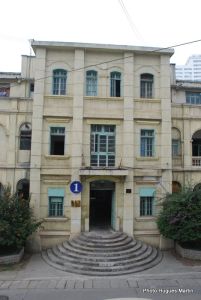
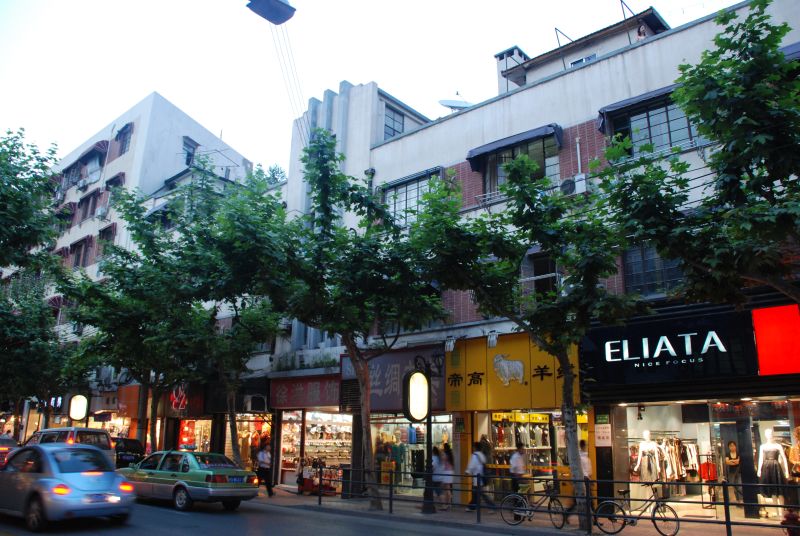
Some of the shops really match the French touch of the bakery with the french touch of the French concession. I particularly enjoy the one at the corner of Avenue Joffre and Avenue Cardinal Mercier (Huai Hai Zhong Lu and Maoming Nan Lu). It is located in the building of the only remaining Shanghai restaurant from the old time (The red house). The bakery fits perfectly in the renovated building, located in one of the best preserved corners of the French Concession, opposite the Cathay theater. Paul creates a modern and fashionnable place to be for the new Shanghai generation, as well as bringing essential confort for the expat community and helping recreate some of the old spirit. This location is fast becoming an essential stop after intense shopping in the cloths shops down the street. It is a revival of the old time when people would browse the highly fashionnable shops of the Avenue Joffre and stop for a coffee around this area (for example in the Cercle Sportif Francais or the Cathay Appartments).
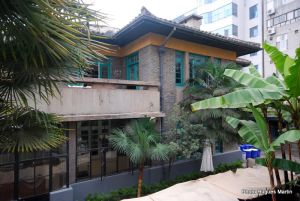
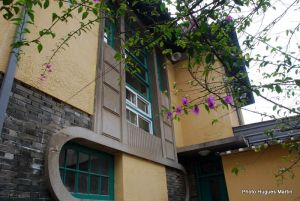
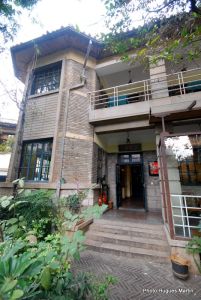
The DongPing lu store is also located in a spot evocating the old time. The shop’s building itself looks old (though it is not), but it is mostly the surrounding that creates the “French Concession” atmosphere. This section of “Rue Francis Garnier” hosted the house of T.V Soong (inherited from his father, where the family grew up), the one of Chiang Kai Check and the one of HH Kung (married with Soong Ailing). The pane trees, small street and old houses along with fresh bread make it feel just like Europe.
I used to bike for 20 minutes to the XinTian Di shop, buy my bread and come back to Jiajia waiting for me with fresh coffee. Riding in the small streets of the french Concession under the pane trees, I felt I was in 1938… not 2008. Instead of going to the Church every Sunday, I would go to Paul every Saturday religiously. Nowadays with the Dong Ping Lu Paul very near to my home in the French concession, getting fresh bread on Saturday morning is just a short walk. Paul has answered the prayers of some of the Shanghai inhabitant, asking for quality bread. Let’s pray for their success and long life in Shanghai.

The Haipai ruler

Going to antic markets is always like a treasure hunt. Finding things is a matter of luck, but also of knowledge. The best example is surely this little envelop that I found last week. I had seen it before but never really noticed it. It’s a pretty banal object, a envelop for a drawing tool that came with it. It has become grey with time and usage but the prints are still clearly visible. The ruler in it is still stainless and nearly as new (see picture below).
Having seen it so many times, what attracted my attention on that occasion is the similarities with pictures in a book I am currently reading about art in the 1920’s and 30’s in old Shanghai, and in particular print art (I will make an introduction to this book in a later post). Reading about the evolution of the fonts used for printing the characters, I could recognize that this one is pretty unusual. The characters used in this very simple object are very carefully designed, in a similar way to the sophisticated youth and art magazines of the time. In particular, the fonts used for the middle characters are really special with very wide vertical strokes against very thin horizontal strokes. The geometrical shape of the characters shows the clear influence of the modern painting and design. There is something “art deco” about it.
This is typical of the the Shanghai style, or Haipai. At written on the envelop, the ruler was made by a Shanghai company. It is a simple drawing tool, an industrial mass consumption product but the envelop design really gave it a very modern look for the time. Along with the “International Brand” ( with the logo with plane and earth), the design gave the impression to the buyer that he was getting a piece of this bright new world on display in magazines and posters. Haipai styling was not limited to newspapers, books and other intellectual objects but also also applied to more usual objects, making them truly Shanghainese. This simple object is a true reflection of Shanghai at that time, a true Shanghai product.

The Nanjing Ticket

KMT flag

This is not strictly about Shanghai, but closely related. The president of the main Taiwanese political party in power has come to visit China this week. In view of the relations between Taiwan and the mainland, this is incredible enough, but the most stunning is that his party is the Kuomintang, i.e. the very party that dominated China, before being chased out by the communists in 1949 and take refuge in Taiwan.

The Kuomintang was founded in Dr Sun Yat Sen in 1912 who is largely seen as the father of the nation on both sides of the straight. From its base in Guandong, the party took over the whole China lead by Chiang Kia Shek in 1927. From that point on the capital of the nation became Nanjing where Dr Sun Yat Sen was also buried.

KMT flag in aviation building Shanghai
The hidden KMT flag

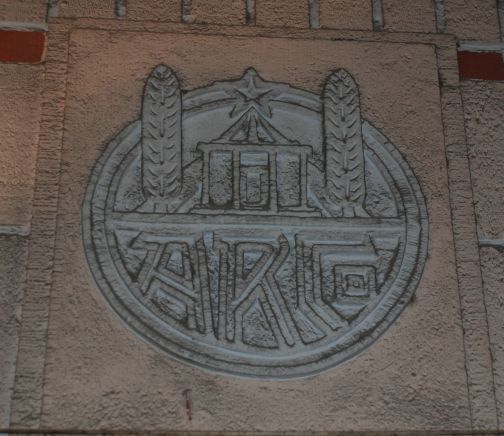
The “Generalissmo” actually spent a lot of time in Shanghai, living in his villa in the French Concession (Dong Ping lu) with his wife Soong Meiling. He was  highly interested in the development of Shanghai as a city, unifying the Chinese city around the foreign concessions and pressing for construction of the Shanghai civic Center in Jiangwan district. The Kuomintang logo used in  decoration of buildings 70 years ago is still visible in today’s Shanghai (like this one in the former aviation society building) though you may have to search a little.

Since Nanjing had such an importance for the Kuomintang’s history, it is not surprising to see the most important visit of he Taiwanese leader in Mainland China to start there. As the Chinese press underlined, the Taiwanese leader came to the city to honor the tumb of the father of the nation, Sun Yat Sen, and because of the “great links between Jiangsu province and Taiwan province”. It is also highly charged in symbolism for the Taiwanese for this visit to start in Nanjing, that used to be the capital of China ruled by the Kuomintang.

Wu Poh-hsiung, the leader of the ruling Kuomintang in the “Republic of China” (i.e. Taiwan) then met the leader of the Communist Party of the People’s Republic of China (Hu Jing Tao) in Nanjing. His visits finished in Shanghai, meeting with Taiwanese businessmen that are in high number in the city. Many Shanghainese families fled to Taiwan (as well as HongKong) after communist liberation in the late forties and many still have ties in the city. Many have come back, some trying to claim the family property confiscated by the government 40 years ago.

From an historical point of view, the visit is of prime importance. The rumors has it that direct flights from mainland to Taiwan are on the way, replacing the indirect flight through Hong Kong. With direct flights to Taipei, Shanghai would be even more of a modern city.

Empire of the Sun

I remember the movie’s poster when it came out in 1987. Steven Spielberg was already famous, though not the star that he is now but the movie was much talked about. I did not see it then, and it’s only recently that I realized its connection with old Shanghai.
Based on life of JG Ballard, Empire of the Sun tells the story of a young English boy left alone in Shanghai during the 1941 Japanese invasion of the International Settlement and his life throughout the war until being re-united with his parents in 1945. The most interesting was that the movie was fully filmed in Shanghai in 1986, before the real estate boom in Shanghai.
The first part of the movie takes place in the city itself and the remake of old Shanghai is simply stunning. The scene on the Suzhou creek bridge is exactly as one can see on the period photographs. The movie makers imported old cars and rebuilt parts that had been destroyed. The scene overlooking the Bund is also amazing with the level of details involved. The Bund used to be a street as well as a parking lot with a little cabin in the middle. The actual movie looks just like the old postcards. They even rebuilt the WWI victory statue that was destroyed during the Japanese occupation of the settlement. There is also a scene in front of a theater that is located just behind the Bund and was used as a club called New York New York a few years later. The movie perfectly rebuilt the crowd and atmosphere of the period and its clear that historians were involved to recreate the past. The most stunning was the documentary on the DVD, showing pictures of the Bund in 1986… helping to understand the enormous work involved for the decors. The film also involved hundreds (if not thousand) of people for creating the enormous crowd of refugees and people pushed back by the Japanese army invading the settlement. One scene was even filmed in the Peace hotel overlooking the Bund. The scenes with the Japanese army coming into the settlement are also very impressive, and must have brought back a lot of memories to many Chinese people who went through this period.
With a good knowledge of Shanghai, it’s also easy to spot the points that were not actually filmed on the spot. In particular, what is supposed to be the Cathay Hotel entrance (with a Cathay Hotel sign) is certainly not the actual hotel entrance. The villa where the boy live with his parents is also not in Shanghai. I have not seen any picture of this particular villa in Shanghai, and it would have been in a much too good state after 40 years of bad treatment. Moreover, buildings where built after 1949 in most gardens of the original villas as the density of people increase rapidely. I believe that the villa scenes inside and outside were filmed in England… in villas from the same period. The neighboring villas are Faux-Tudor like the ones in Shanghai and were probably built in the same period as well.
Finally, the camp scenes were not filmed in China. First of all, the sandy desert ground is surely not in the Shanghai region but looks much more like spain (one of the filming location). However, the style of the buildings re-created is very near to the original Shanghai style and the remake of the LongHua Pagoda (near which JG Ballart was actually interned) is also very close to the original. The only thing missing is the LongHua airport terminal that would have been between the tracks and the pagoda… i.e. exactly where the camp is build. One point I am not sure of yet, is where the green house of the ending scene is. It could be the one of the Shanghai botanical garden, but it also could be in many other places.
In any case, the remake of old Shanghai in the city itself is just amazing, and the attention to details given to the other parts of the movie make it a must see for Old Shanghai enthusiasts. For current Shanghai resident, it is amazing to see how Xu Jia Hui looked like before thre real estate boom of the 90’s and later. I wish the more recent movies about old Shanghai would pay such an attention to details.

Breaking the wall

If you are a frequent reader of Shanghailander.net, you probably have realised that the blog has changed of provider a few times recently. This has been quite a pain and took a lot of time away from actual writing but was necessary. Until a few days ago, Shanghailander.net could not be read from China… This has finally been changed by moving the whole blog to my own platform instead of a blog provider. Since typepad.com (my old platform) is still not accessible from China.. this was the only way. I am still not happy totally with the result… but the main point is “My blog about Shanghai can finally be read in Shanghai”. Enjoy reading

Promenades au coeur de l’ancienne Concession Française

I always try to write unbiased book reviews… but this one will be a bit different, since I have been involved in creating the book. “Promenades au coeur de l’ancienne concession française” is the new version of an older guide about Shanghai’s former French concession. As the original one, this book was made by “A pleines mains” an expat charity in Shanghai with proceeds used in various help projects in Shanghai and surrounding cities. The original guide was published in 2002 and has become out of print.

The new version published in 2008 includes a number of guided walks throughout the former French Concession. Each walk is about one hour and can easily fit into a busy afternoon shopping or as a short break in a business trip. Walks are spread around the old French Concession and the adjacent Xu Jia Hui area. One of them passes by the entrance of the lane where I live. Fortunately, my house is not included… keeping my little private Shanghai quiet. (I left this location in 2015, see post “Leaving Route Kaufmann“.)

The book is both in French and English, ensuring that the information collected by the large French community in the city is spread out to every lover of the old Shanghai. The original text was written in 2001 and the original author interviewed a few remaining Chinese survivors of the Concession time. This adds anecdotes and real stories to the book, making it a lively read. Having been interested in the topic for a few years, I still managed to learn quite a few things from it.

I did not design the walks, but I contributed with my own collection of old Shanghai postcards and documents to be used as illustration. I am quite proud of having been part of it as the result is really good. If you are looking for a practical book about old Shanghai, it’s a good point to start.

An update to the book was added in 2013. Some of the sites visited have now been teared down, but the book is still relevant. Unfortunately, this particular book has never been reprinted and has become very difficult to find nowadays. Another very good series of guide books for walks around Shanghai is the Shanghai Walks series that was coordinated by Tess Johnston. Since they were also printed in small number, they are also very difficult to find nowadays.

The perfect Sunday

My Shanghai bikeWarm weather finally has come to Shanghai. Spring 2008 was just a nightmare with gray sky every day for weeks and temperatures remaining around 12 degrees… when they should be above 20. Spring is one of the best time in Shanghai along with autumn… and it has finally started this year. This was an opportunity to spend a great Sunday. A day like this is the best antidote to the restlessness of the city that drives people mad at one point or another.
The perfect Sunday starts with waking up around 9 or 10 am and write or read a little on the balcony. The garden of the old house we live in is full of trees and green leafs have just come out, obscuring the view from all the neighbors. Birds sing in the trees, they create a countryside atmosphere right in the middle of the city. Drinking coffee on the balcony while writing or reading, I just enjoy the view. While Jiajia is waking up, I take my bike to the Paul bakery on Dong Ping Lu a few roads down. I often meet friends in this neighborhood, taking time to chat while buying croissants for breakfast. After eating French pastry and more of the balcony, I jump on my bike again for a trip to the old city.
The peak time of my perfect Sunday is biking along the streets of the former French Concession. I cruise on my bike under the shadow of plane trees. Passing by the old houses, it really feels like I am back in 1930’s Shanghai. I generally take Route de Seyes (Yong Jia Lu) up to Route Delastres (Tai Yuan Lu), then going on Fuxing Lu all along the way. Rue Lafayette (the old name of Fuxing Lu) is a one way street with a large bike lane. Crossing right through the whole of the French Concession, it has kept a lot of its old buildings and is still very charming. The end of Fuxing Lu reach into the old Chinese City… that now exists only in some people imagination since most buildings have been destroyed. Fan Bang Lu and Dong Tai Lu antique markets or Wen Miao Temple book market are my favorite places to go to.
Walking through the lines of shops, one needs a lot of attention to spot anything valuable amongst the stacks of stuff piled around. The most interesting sellers are the ones that get in bulk straight the demolition works. They are not the most appealing but something they have hidden gems. Most of the items are of little if any value… but you may find something interesting. This is when strong bargaining is required as the asking price is often beyond any reason. After shopping, I jump back on my back, going home via one of my favorite coffee place on Route Cassini (Taikang Lu) or Citizen Cafe (Jinxian Lu) and enjoying diner with a few friends. This is my perfect Sunday in Shanghai.

Climbing Zo Se (She Shan nowadays)

The Shanghai hills are the nearest thing to a mountain near the city. Driving there takes about 1 hour from the center if traffic is good. Located in the East of the city, it is quite near from the major expatriates area of HongQiao and HuQinPing. Since the opening of the Meridien hotel, it has become popular spot for Sunday family outing. While indulging with delicacies, few people seem to be aware of the hill’s history and climb to the top of it.

In the old Shanghai time, SheShan was known as Zose (Sheshan in Shanghainese). The name was also the one of the village at the bottom of the hill. The attraction on the hill was the Observatory established in 1900 by the Jesuits fathers. It was one of the most advanced observatory in Asia. Weather informations were gathered from all over Asia, to be able to predict the weather for sea transportation. Information was sent to Shanghai French Bund for display on the Guslav Tower. The observatory has now been turned into a museum but is still nice to visit.

Old Amex Guide to Shanghai

The location is mentioned as an interesting excursion from Shanghai in the American Express guide for “Sigthseeing in and around Shanghai” from 1934. The return trip to the hill took then 1 full day starting with train  from “Shanghai North Station at 7.10 a.m” arriving at “Sungkiang 8:39am”. (Songjiang is now a part of Shanghai, with a metro line reaching is in less than 1/2 hour.) Traveller would then take a boat on the canals reaching Zose “in about 2 and half hour”. The guide also recommended to take your own picnic (in a picnic basket) to eat after climbing the hill before going back to Shanghai in a journey of about 4 hours by the same way. It even propose “a more leisurely alternative” in taking a boat on the Suzhou Creek from Shanghai to reach Zose in the evening and climb the hill the next morning. People climbed the hill enjoy the landscape of “surrounding plains, with their villages and cultivated fields and waterways winding like silver bands.” Rice paddies in that part of Shanghai are long gone, and villages have been replaced by compounds of luxurious villas but the viewing is still very nice from up there.

What is not mentioned on this guide from 1934… is the She Shan Basilica built by the Jesuits and finished in 1935. The cathedral is the largest in Asia, dominating the surrounding planes. It is very impressive and has  been well renovated, after damages done during cultural revolution. Like XuJiaHui Saint-Ignacius Cathedral, it is a strong symbol of the Jesuits presence in this part of the world.

Shanghailander articles are published on an irregular basis. To be notified when a new article is posted, subscribe to the newsletter using this link, or follow the Shanghailander Facebook page.

Red Mandarin dress

This is the fifth novel of inspector Chen. I read the four others last year, after having seen author Qiu Xiaolong speaking at the Shanghai International Literary festival. The other novels were really enjoyable, so I could not wait to read this one. At first, it seemed just like another inspector Chen novel. Another young chinese girl killed in strange circumstances in Shanghai in the late nineties. Once again, the novel start with a crime that inspector Chen has to solve… this sounds very much like every inspector Chen novels. But this one deviates from the normal course really fast as the killer starts again one week later.

Putting the corpses in very visible location (first on Dong Hu lu / Huai Hai lu), on People Square the murderer is sure to create heavy publicity for himself… just at the time when our favorite inspector is putting his job on the back burner… I won’t spoil it all by telling the end, but this new novel is a page turner.

Qiu Xialong novels also evolve one after the other. They are all happening in the 90’s in Shanghai, but this one clearly includes a number of element that are more from 2000 Shanghai than 1990. From one novel to the next, we see the character’s life evolving and the city change. Part of the intrigue is still based on the Cultural Revolution period and dark secrets from this time come back to the surface many years later, but the whole topic also becomes broader including more part of Shanghai’s history. At the same time, the novel keeps in touch with the city’s reality and depicting the specific atmosphere of the transforming city. Reading it was a couple of hours of pure enjoyment.

Red Mandarin dress is a great Shanghai crime novel, but if you are looking for crime novels in Old Shanghai, Tom Brady’s “The master of rain” and Inspector Danilov’s “Death in Shanghai” are recommended. For French readers, Bruno Birolli’s “Le music-hall des espions” is also a great choice.

Reaching Heaven

Saint-Ignace cathedral was a famous landmark of the Old Shanghai. Built by the Jesuits in 1906 at the spot of any earlier one, its two towers were clearly visible from far away. The Catholic cathedral was located in the Jesuits estate in Shanghai, just outside the border of the French concession. The building suffered a lot during cultural revolution, with both towers severely damaged. It was rebuilt in the 1990’s and now looks more or less like the original. It is open again for religious services for Chinese catholic Church, for Chinese people only.

The Church may look like the original, but two things have changed. First of all the environment has been totally transformed along those years. The cathedral used to be visible miles away, it is now dwarfed by neighboring buildings and shopping centers. Furthermore, the original stained glasses have disappeared, replaced by plain glass. People are working on trying to put back stained glassed in the cathedral. I recently attended a charity concert to raise money to support this project. I was very much looking for it, as concerts in the church are something unheard of and I was not disappointed.

That night’s weather was perfect for it. It had rained the whole day giving a gloomy atmosphere to the city. I was running through the continuous rain, finally getting in after a bit of struggle with the security. The room was full with people, but it was the quietest concert crowd I have ever seen in China. Silence came and shortly after I got in, the Chinese philharmonic orchestra started to play Mozart’s requiem. In this extraordinary of the cathedral and the excellent music, one could quickly feel like we were in 1928, not 2008. It was really a touching moment to be able to experience this great music in such an historical place. That moment was really straight out of the movie “Empire of the Sun“.

The concert finally ended after dies irea, and the crowd of the Shanghai foreign and Chinese high society that was there could have also very well belonged to the 20’s or the 30’s. The succession of big cars and white gloves drivers at the exit perfectly completed the old Shanghai atmosphere. In the night, you could see the car lights only and the rain helped keeping noise from the nearby avenue down. I was walking under the rain in my trench coat, feeling once again in a time travel to old Shanghai enjoying this wonderful and unique evening.