Embroidery pattern book

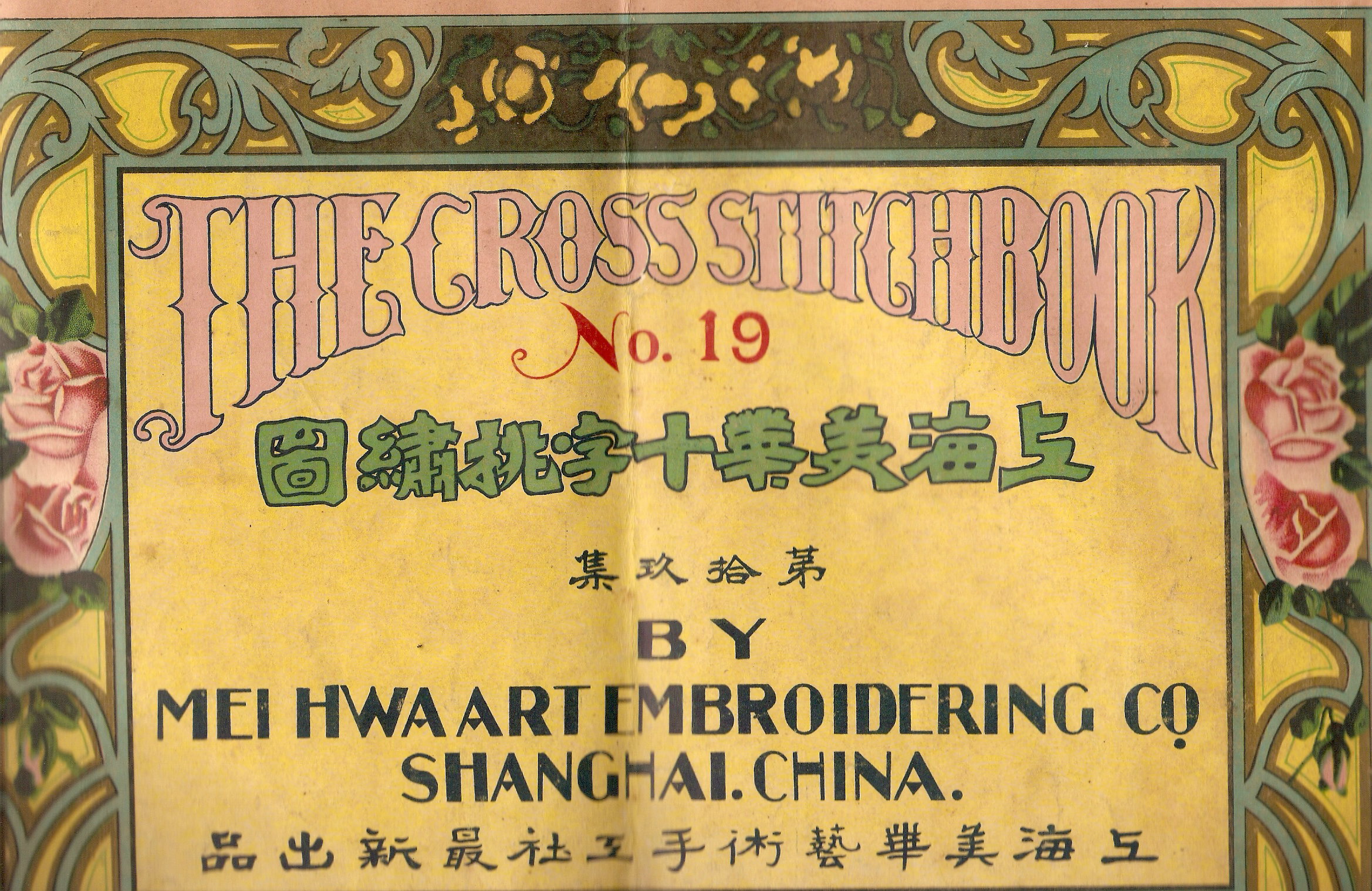
Traditional Embroidery has been used as decoration for fabrics in China for centuries. European style embroidery was imported in China by foreigners and must have gained popularity in Old Shanghai. The below book is an embroidery pattern book combining western cross-stitch technique with Chinese style design, found in an antique market a few year ago. This must have been a popular publication as this particular one is N 19.

Old Shanghai embroidery pattern book

This book was clearly not an import, but a Shanghai creation. Spinning was one of the major industry in Shanghai, creating embroidery books helped sell their products. (All names are written from right to left, as it as written at the time).

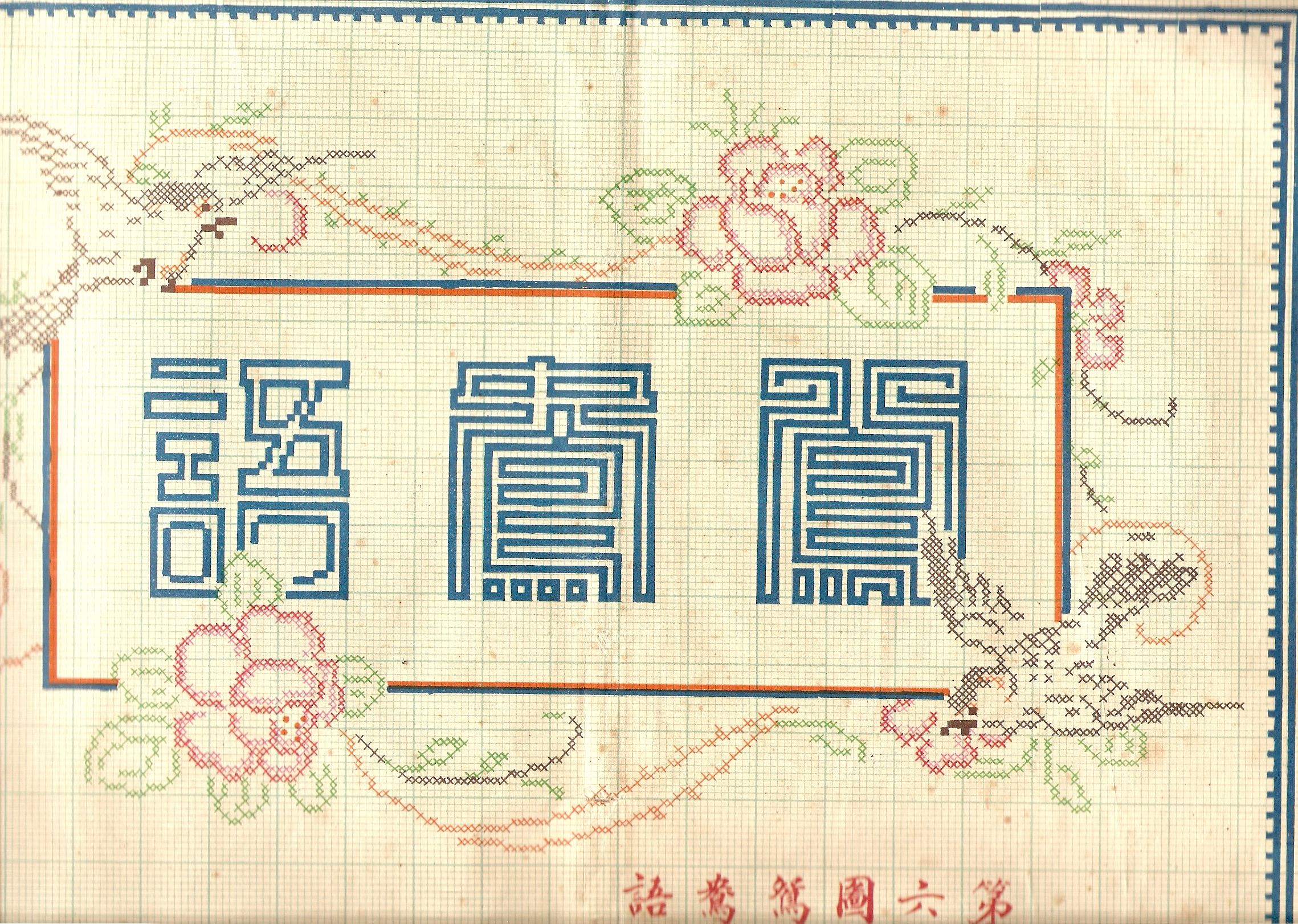
鸳鸯语

The Mandarin Duck speach character combination is a traditional Chinese way to wish harmony in the couple.

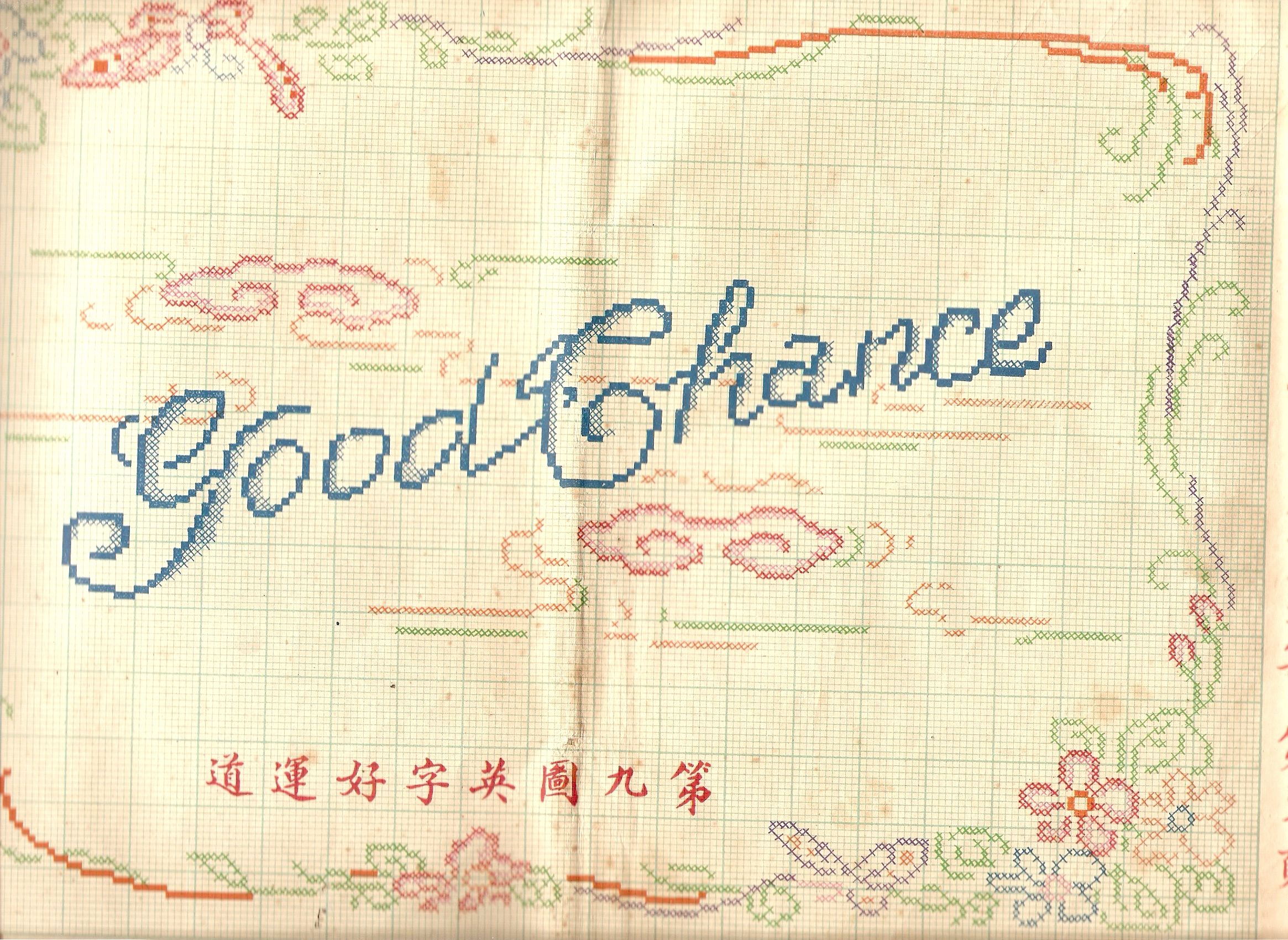
Good Chance embroidery pattern

Although some English text was used in the booklet, it was not designed for foreigners. It even includes an explanation in Chinese of the meaning of “Good Chance”, which is actually not proper English as the expression actually means “high probability” as opposed to “good luck” as implied in the pattern.

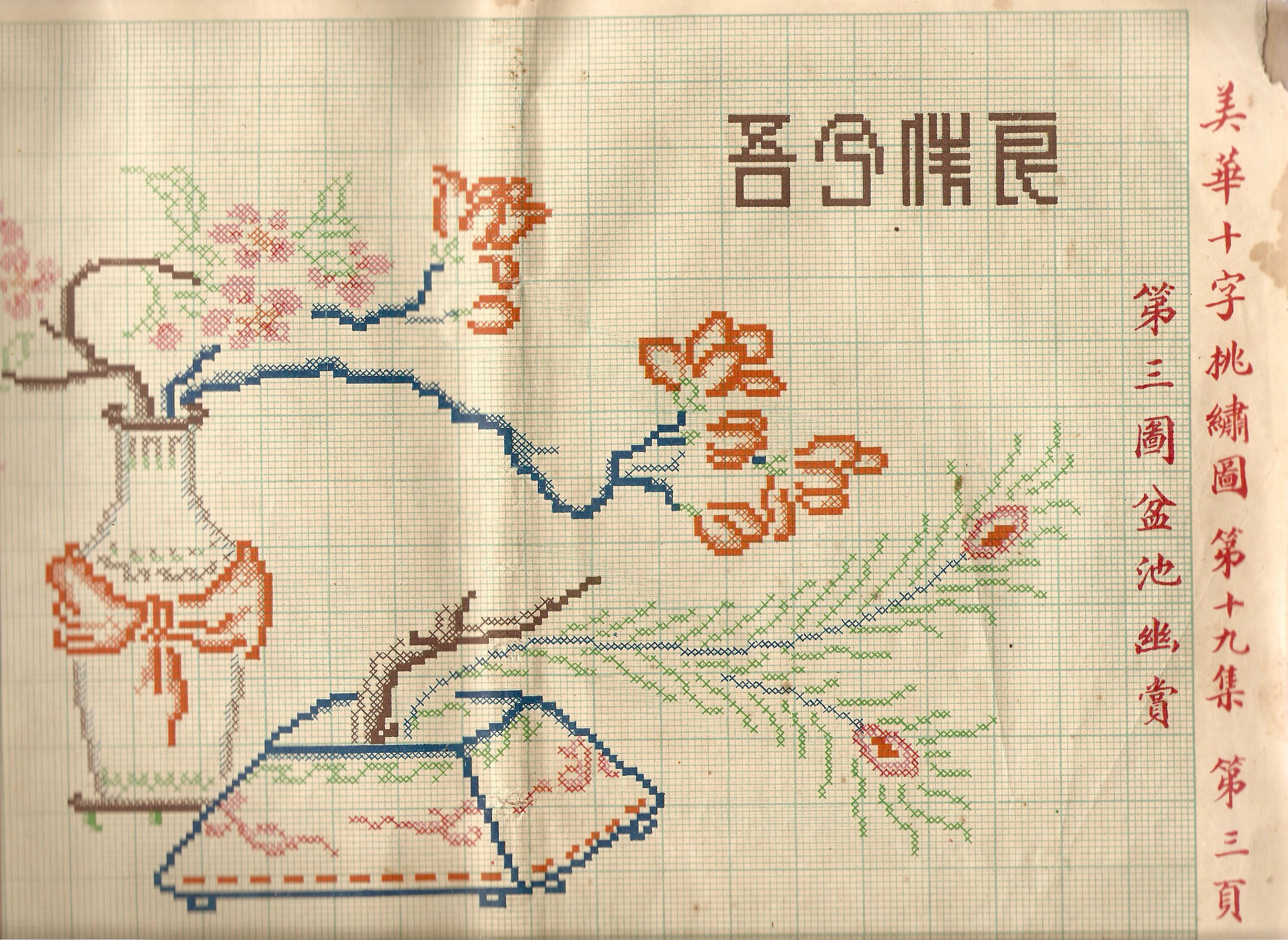
Bonzai cross-stitch pattern

Finaly the last illustration is of Bonzai, another traditionnal motifs in Chinese culture.

I did find embroidery thread in an antique market, but they were imported ones from France. Locally made sewing thread was locally manufactured, as shown in post “Made in Shanghai“.

Old Shanghai was a fascinating place were traditionnal Chinese culture (in particular South West China) tradition was mixing with Western Culture. The specific style of the period was known as Haipai ( 海派) style, the Shanghai style. Another exemple of Haipai style object can be found in post “The Haipai Ruler“, or in cigarette advertising like the one for “Russian-China Tobacco Ltd“.

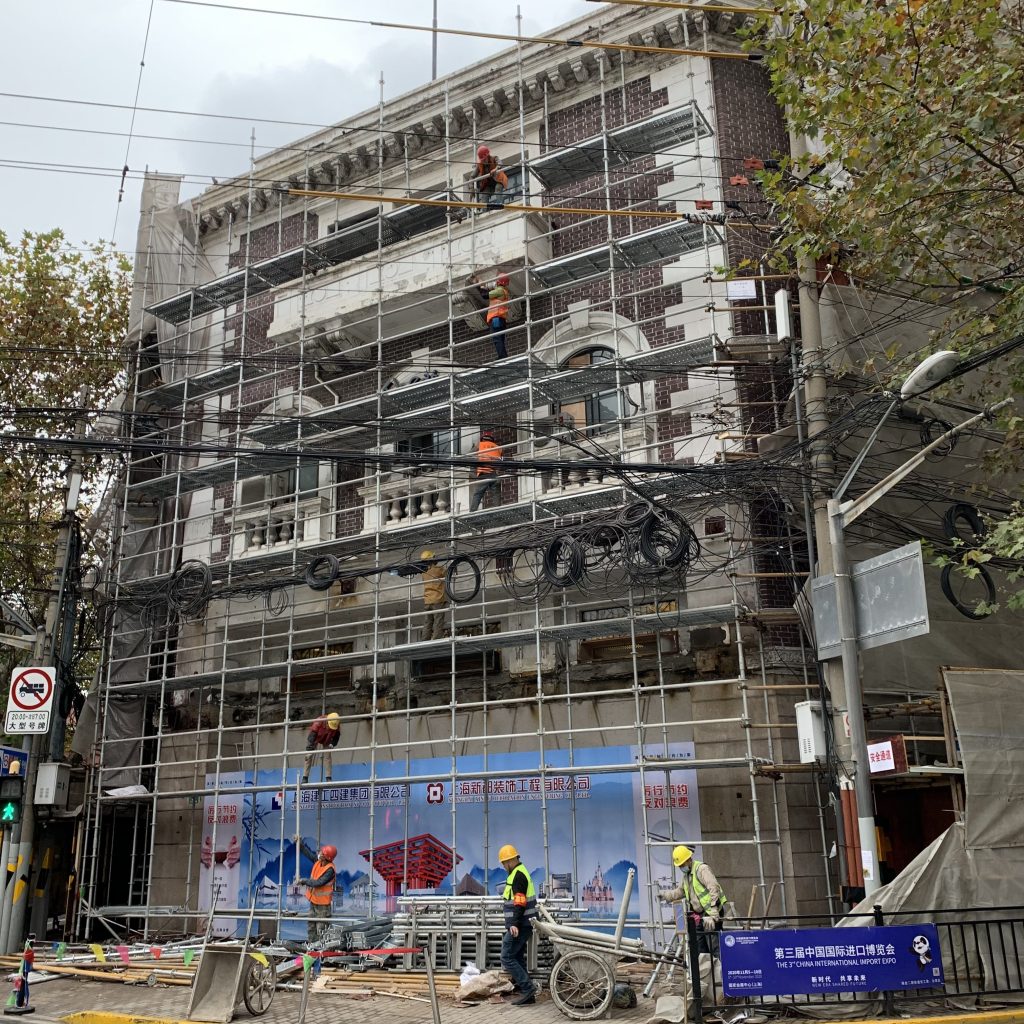
Renovation on Lyceum Theater

Seeing scaffoldings on a Old Shanghai building is always scary, as this can be the sign of future destruction, or a really bad renovation (See post Plaza 353 ruinovation for more info).

I recently passed by Lyceum theater at the corner of Rue Bourgeat and Route Cardinal Mercier (today Changde Lu and Maoming Nan Lu), to discover the building wrapped in plastic. Since shows are not taking place due to CoVid pandemic, it is probably a good timing for renovation. Not sure how it will turn, but will keep a look for it.

Chinatown, the movie

Although it is considered one of the best neo-noir movies, I had somehow missed this one until recently. Based in LA in 1937, the 1974 Roman Polanski movie staring Jack Nicholson is an acclaimed classic of the genre.

Late 30s period costums

The director spent a lot of time and energy recreating LA in the 30s, with spectacular result. This make the movie very relevant for this blog as fashion, cars and building were quite similar to the ones in the former French Concession and International Settlement at the same time. The only surprising part is the lack of Art Deco buildings in the movie, but most buildings are Mexican or Spanish Revival style that was also popular in Shanghai in the same period.

Just like the movie ” Casablanca” , Chinatown gives a pretty clear feel for the period dress and decor that was very similar in Old Shanghai. I can imagine that it was used as a base for Old Shanghai movies like 2010 “Shanghai” or “Tian Tang Kou“.

Films noirs and period movies like Chinatown must have also been an inspiration for neo noir writers including James Ellroy. See post “Perfidia” about his book. I am long searched for a really good noir book taking place in Old Shanghai. Paul French’s “City of devils” is pretty close to that though it’s not a novel.

Sung Sung dairy box

One of the latest post on Shanghailander, was focusing on milk distribution in Old Shanghai (See post “Shanghai Milkman” for more details). Among other things, I was showing an antic milk box from Culty Dairy. Soon after publication, a Shanghai antic dealer came to me with pictures of another milk box, from a different dairy company.

The box is much bigger than the Culty Dairy one, so maybe it was for a large family.

Sung Sung Dairy (生生牧场) was located at 175 Great Western Road (大西路175号), now the parking of Longemont hotel on West Yan’an Rd, close to Panyu Rd and to the Columbia country club (now site of modern Columbia Circle). In the 1947 Shanghai telephone directory, it was listed as Sun-Shine dairy.

French Master of Shanghai Art Deco

Le Petit Journal Shanghai edition has republished an article about Art Deco in Shanghai, focusing mostly on the work of Léonard, Vesseyre and Kruze firm. I wrote the article together with my friend David Maurizot in 2018.

The article is in French only and can be found following the link below:

https://lepetitjournal.com/shanghai/a-voir-a-faire/promenade-historique-les-maitres-francais-de-lart-deco-shanghai-221435

It’s a great way to enjoy autumn in Shanghai.

Shanghai Milkman

Daily milk delivery has been a feature of English life since the end of the 19th Century. The milkman service was a full part of British culture, with 94% of the milk consumed delivered by the door in 1974. This is probably best illustrated by the 1966 British hit “No Milk Today”. Similar service was also available in Holland and in the USA. Being of such importance in the UK, it is of no surprise that a milkman service was available in Old Shanghai. What is more amazing, is that the service has survived in Shanghai and is still available nowadays.

Milk and milk products were an essential trade for European settlements in Asia, including Old Shanghai (see post “milk and butter” for more details). As the population of Old Shanghai grew, European farming was developed to supply local customers, including dairy products. They were quite a number of dairy farms in Shanghai, including the Liberty Diary on Connaught Road, in the International Settlement (today Kanding Lu), the Standard Milk Company on Great Western Road (today Yanan Xi Lu), or Model Diary Farm on Tifeng Road (today Wulumuqi Bei Lu).

1938 ad for The Liberty Diary
Standard Milk Co ad – Picture MOFBA

The most famous then and today being probably the Culty dairy, located at the corner of Avenue Joffre and Route Culty, today’s location of Shanghai librairy on Huai Hai Zhong Lu. It was a few step away from Hungarian architect Béla Matrai’s home and most well know building.

Shanghai libray, former location of the Culty Dairy

Just like in the UK , milk was delivered daily in glass bottles. Every customer received a small metal box that was hanged outside the house, like the one pictures below. Early morning, the milkman would come, collect empty bottles from the previous day and put filled bottle instead. Bottles were normally half pints, i.e. 236 ml. Milk was delivered and consumed within a short time, it did not really need refrigeration.

Although milk is now mostly sold in cartons, using refrigators, the milkman service is still available in Shanghai, with milk delivered early morning daily. The little box is made of plastic, not of metal anymore but form and function are similar. Glass bottles are 195 ml, that is pretty close to the half pint.

Since very little packaging is used, this is also an environment friendly way of getting your milk. Bright food group was born form the merger of several food companies in Shanghai, including the Yimin N1 food company, the original ice cream company in Shanghai. They probably also included some of the former dairy farms and milk company, including Sun-Shine dairy, so service continued all those years. Bright also owns the Aquarius water and soda brand, that was available in Old Shanghai.

Now that I am regular customer, I enjoy my daily milk just like in Old Shanghai. This is a revival experience, similar to enjoying unchanged palmier from Park Hotel, or having lunch in Old Shanghai Deda Cafe.

Collecting memories

Having lived in Shanghai for more than 16 years, I have seen tremendous changes in the city and the mentality of its inhabitants, in particular regarding the city’s past. The attitude has changed tremendously, with a new trend for collecting the past and old artefacts, as shown in a recent Sithtone article on the topic.

During my first trip in 1998, Shanghai was for from being the trade center it is today. The city was still pretty much emerging from it’s 40 years sleep, at least in terms of architecture. There was many cranes and construction, and I did not pay any attention to the past.

My first book about Shanghai history

It’s a few months after I came back in 2004, that I started to get interested in Old Shanghai. It must have been on a March or April walk on the former Rue Lafayette (today Fuxing Lu), that things started to piece together. There was very few books on the topic, and finding them in Shanghai was not always easy. I remember that the first real book I read about Shanghai history was 2000 Stella Dong’s “Shanghai, the rise and fall of a decadent city”. I started to collect items from the old Shanghai period from 2005 or 2006, going to antique and later book markets. This lead to the creation of this blog in July 2006 (original called Shanghai Old and New, see opening post) and was weird enough to attract the attention of a reporter from Shanghai Daily, and a number of others later.

Having told the story of Shanghai many times, I can see that a younger generation of Shanghainese is getting interested in their own city and its history. Some of my friends believe that Shanghai antiques could become the new trend for people here. I am not sure about it, but I still enjoy researching this incredible period of Old Shanghai.

Béla Mátrai, Hungarian architect in Shanghai

Having lived for years in Budapest before coming to Shanghai, I still feel connected to Hungary after all those years (see post Budapest Old and New). As explained in post ” Looking for Hudec“, discovering about the Hungarian architect in 2008 was a big surprise and I could see the parallel with my own travel from Budapest to Shanghai, actually visiting Hudec alma mater during one of my trips there. At the same time, it was also an eye opener into the incredible vitality of Hungary’s architecture before and after WW1 (see post Budapest Art Deco for more details).

Thanks to the research of the Livia Szentmartoni Consul for Culture at Consulate General of Hungary in Shanghai, it turns out that Hudec was not the only Hungarian architect in town. Her 2019 book as put Karoly Gonda’s work into light, and while both Hudec and Gonda came from Hungary, there was little connection beetween both. 2020 brought news of another Hungarian architect in Shanghai, Béla Mátrai.

Picture National Archives of Hungary / János Mátyás Balogh

Just like Hudec, Mátrai was a Hungarian trained architect, taken prisonner during WW1, sent to Siberia and finally arriving in Shanghai in the 1920s. It is unknown whether both men knew each other before Shanghai, but Mátrai worked a number of years for Lászlo Hudec firm. He is part of the team creating Park Hotel, a project that lasted from 1929 until completion of the building in 1934. Mátrai was listed as “field assistant to Laszlo Hudec” (source Poncellini 2007). Although unverified, it is very likely that he was also involved in other major Hudec projects before Park Hotel, including The Grand Theater and the Women College of Université Aurore.

In a similar way to Hudec a few years before, he left Hudec firm sometime in the early 1930s to create his own firm. One of his first design was the Modernist apartment building on 273 Route Culty (today Hunan Lu), completed in 1934. He had is office on 278 Route Culty, on the other side of the street.

273 Hunan Lu – Picture Livia Szentmartoni

Interestingly, I had recently visited an apartment in this building, while noticing the floor tile pattern (see post “More on tile pattern” for more details). Here is below a picture of the South garden side, that cannot be seen from the street.

The design of the apartment was very modern with 2 large bedrooms, a large combined dining and sitting room. Kitchen was very much in original condition, including the original wall mounted foldable ironing board. The apartments in this building also have an underground cellar, which is very rare in Shanghai.

The large South oriented windows gave a lot of light and a very modern feeling. I am not sure how it feels with the cold and damp Shanghai winter, though. It was definitely a modern apartment for a wealthy modern family in the 1930s.

According to official Hungarian sources, Mátrai married a Russian lady in 1924. They had 2 children, Margit & Jeno. They divorced in 1935 and Mátrai married Lucy (Ludmila) Dobrjansky. At the end of his time in Shanghai, he sent his children away in 1947 and left Shanghai on 13th March 1948. He settled with Lucy in Glen Ellen (Sonoma, California). Lászlo Hudec settled and died in Berkeley, California… about 80 km away. Somehow, Mátrai followed Hudec path for most of his life.

Sino-Belgian Tobacco Co

Smoking tobacco in China existed long before the establishment of foreign Concessions, but cigarettes were definitely brought by foreigners. Although they were probably invented in South America, Cigarettes get their name from French as the were first largely smoked and produced first in France in the 1830s. The tobacco product became more and more popular worldwide after the development of cigarette manufacturing machines in the 1880s. By the 1920s, cigarette was known in most part of the World and was strongly linked with the export of Holywood movies.

Shanghai was no exception and served as a base for selling cigarettes all over China. The largest companies were British American tobacco and Nanyang brothers which both had their China headquarters in Shanghai. Cigarette manufacturing and trading was a massive and very lucrative business. Many local and foreign companies tried to get a piece of the market, including Russian-China cigarettes company mentioned in a previous article.

I bought the box pictured above a long time ago in an antic market. The long shape of the box was unusual (I later learned that it was to contain 100 cigarettes) and company name “Sino-Belgian Tobacco Co” attracted by attention. Since I never heard about this company, I assumed it was a local company made by a Belgian in Shanghai with Chinese partners. It definitely looked like a foreign brand packaging.

At first, I only found little information about the Sino-Belgian Tobacco Co. Only a couple of boxes like this showed up on the internet, but I later got some better results: Sino-Belgian Tobacco Co (華比煙草公司), incorporated 1919 at 147 Seward Road, later relocated to 1176 Woosung Road. It was actually created by two Belgian people, but I don’t have their names. Both location were in Hongkou, the original industrial district of Shanghai that expanded later into today’s Yangpu district. The building on Wusong lu (pictured below) has disappeared, probably destroyed when the road was enlarged, if not before.

Like other cigarette brands, it published advertising posters. This one is probably from the late 1930s or 40s with it’s geometrical font and simple motives.

Picture MOFBA

I later bought the below smaller box from the same brand, and found the matching advertising.

This image has an empty alt attribute; its file name is Captain-Cigarettes-small-2.jpg
Picture MOFBA

Although I mostly mentioned Captain Cigarettes brand (船主 / 克浦), but they also had other brands including Young Lady (名妹) pictured below, Jockey (新骑师) and 大仙烏牌.

Picture MOFBA

Hazelwood Ice Cream

Brands of products in Old Shanghai have long been of interest to me (See post “Brands of Old Shanghai” for more details. After recently been interested in Coca-Cola and Aquarius drinks brands and advertising, I was sent the above ad by a friend. This probably a newspaper cut or a flyer. Although it displays numerous brands I got particularly interested in Hazelwood ice creams.

Hazelwood Ice Cream was made and sold in Shanghai by American merchant Henningsen Producing Company, Ltd. which was founded in 1889 by Danish businessman Fred Henningsen and his four sons. On April 6, 1919, a report stated that the American Haining Company sold imported milk in Shanghai. In 1926, Haining Yanghang’s ice cream products were launched in large numbers, with the English brand name “Hazelwood” and the Chinese name “Lotus” brand.

Hazelwood factory in Shanghai

Above sketch by German artist David L Bloch, shows the Hazelwood factory in Shanghai, with the brand written on the delivery trucks. Although it displays profiles Shanghai landmark such as The Great World, Grosvenor House, the Cathay Hotel and Bank of China on the Bund, it’s probably not a reliable indication of the factory location, that is unknown.

Hazelwood was distributing cooling equipment to ice cream resellers, just like today. The above machines were ready for distribution. (picture source for above and below pictures: Tong Bingxue Twitter account).

The introduction of a full set of cold beverage production equipment from the USA allowed to mass produce multi-price products, adopting new-style refrigeration equipment and popular marketing methods. The brand name was also changed to “Beauty” brand. The products quickly occupied the market and achieved an absolute monopoly in the ice cream industry in Shanghai. It was sold in Nanjing, Suzhou, Hangzhou and other places. In 1938, the North American Refrigeration Company also produced “Miracle” ice cream.

Hazelwood ice cream ad from 1938

Henningsen Production company was later changed to Shanghai Yimin Food No. 1 Factory, 上海益民食品一厂 that is still active today.